Congress has spent this year arguing over what an AI "kill switch" would even shut off, and how much autonomy an agent swarm should be allowed before it counts as a security risk. Almost none of those bills touch a constraint that is already setting the pace of AI's growth right now: physical manufacturing capacity that takes years to build, no matter how much money shows up looking to speed it along.
The Optics Problem
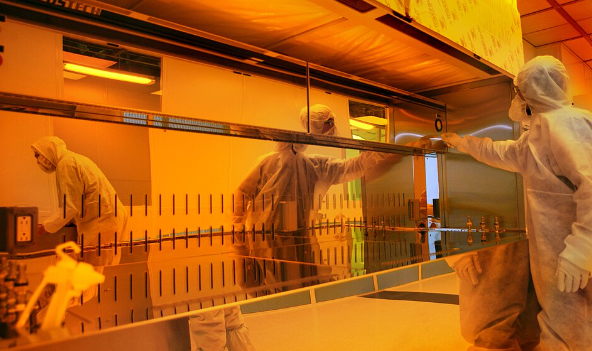
Every extreme ultraviolet lithography machine ASML sells depends on optics built by Zeiss, and Zeiss builds them in exactly two places on Earth: Oberkochen and Wetzlar, both in Germany. Zeiss's own numbers put the manufacturing time for a single High-NA mirror at around a year, and verifying the finished optics requires a purpose-built vacuum chamber measuring 5 by 10 meters, assembled from more than 100,000 parts and weighing over 150 tons. "High-NA" refers to numerical aperture, essentially how wide the lens system opens. A wider aperture focuses light into a tighter spot, the same principle as a camera lens, which is what lets ASML's newest machines print smaller circuits than the older "Low-NA" generation could.
Staff moved into the first building of a new Zeiss production expansion at Oberkochen this past July, four years after the 2022 groundbreaking, adding roughly 25,000 square meters of space; the production halls inside it are still coming online in stages. ASML purchased €4.41 billion in optics and equipment from Zeiss SMT in 2025 alone and is still carrying €1.91 billion in loans receivable from its own supplier, a sign of how much of ASML's balance sheet is tied up keeping Zeiss funded enough to keep building. ASML is targeting a roughly 30% increase in Low-NA EUV output for 2027, up from about 65 systems a year, with another 30% increase under evaluation for 2028, and 2027 capacity is already nearly booked. The company is separately working to compress its own scanner assembly cycle from about 22 weeks down to 15 or 16, real progress on the part of the process ASML controls. What it can't touch is the mirror itself. A component Zeiss says takes about a year to manufacture takes about a year to manufacture, whichever company is paying for it.
Elon Musk appears to be betting on a different fix, though not quite the one it's often described as. After unveiling Terafab, Musk posted two words on X: "FEL FTW." FEL stands for free-electron laser, a different way of generating the extreme ultraviolet light chipmaking requires, one that theoretically needs a fraction of the power ASML's current lasers use and skips the tin contamination that plagues today's systems. What FEL does not do is replace Zeiss. It's a light source, not an optical column, and Terafab would still need mirrors from Oberkochen or Wetzlar to focus that light onto a chip. The technology itself is also unproven: no company has ever shipped a working FEL light source into a high-volume chip scanner. The furthest along is xLight, led by former Intel CEO Pat Gelsinger, which has already collected a $40 million venture round and a $150 million federal CHIPS Act award, and is now in talks to raise $350 million more from Boardman Bay Capital Management and Bain Capital. Even xLight is only promising a working prototype, not a production-ready light source inside a high-volume scanner, at a single site in Albany, New York, at the earliest in 2028.
The Power Problem
Optics is only the first link. Even a chip that gets made still needs somewhere to run, and data center electricity demand is testing the people paid to forecast it. BloombergNEF put U.S. data center demand at 106 gigawatts by 2035 in a December 2025 outlook. By July 2026 the same firm had raised that figure to 194 gigawatts, an 83% increase in seven months, and said data centers could account for roughly a fifth of all U.S. electricity by the middle of the next decade, up from about 6% today. BNEF separately published a second model built from projected chip shipments that puts 2033 demand as high as 207 gigawatts, tens of gigawatts above its own base case for that year. The firm has reason to hedge: it underestimated 2025's actual installed capacity by 16%. Mark Daly, BNEF's head of technology and innovation, told reporters the U.S. is "a really tough environment to build data centers right now," pointing to competition for labor and equipment, political opposition, and grid interconnection delays; BNEF has tracked 124 gigawatts of announced on-site gas capacity nationwide and says only a small share of it is actually under construction. Treat 194 gigawatts as a moving target. The 83% revision in one forecasting cycle says more about how fast this is shifting than any single destination number does.
The standard fix is more natural gas power plants, and that runs into its own bottleneck: turbines. Lead time on a new combined-cycle gas plant stretched from three and a half years in 2023 to five years in 2025, and the price to build a new plant rose from under $1,500 per kilowatt in 2023 to $2,157 last year, a 49% jump. Gas turbine equipment alone, which makes up close to a third of a plant's total cost, is projected to be 195% above 2019 prices by the end of this year.
GE Vernova's combined backlog and slot reservations reached 116 gigawatts in the second quarter of 2026, up from 100 gigawatts the quarter before, and the company is targeting 125 gigawatts by the end of the year. CEO Scott Strazik said GE Vernova is already booking reservations for 2031 delivery and expects to be more than halfway contracted for that year by December. A meaningful share of that backlog is slot reservations rather than turbines under firm contract, but even the reservation queue now runs five years out. Siemens Energy nearly doubled its own turbine sales between 2024 and 2025 and is putting $1 billion into expanding U.S. manufacturing just to keep pace.
The Memory Problem
The third constraint sits inside the chip itself. High-bandwidth memory, the specialized chips that feed data to a GPU fast enough to keep it working, is controlled almost entirely by three companies, SK Hynix, Samsung and Micron. On Sept. 7, KB Securities reported that Samsung and SK Hynix are both holding fewer than 10 days of finished memory inventory. KB's head of research, Kim Dong-won, called the year ahead the tightest supply conditions in the industry's history. In a July 10 interview on the day SK Hynix's Nasdaq listing began trading, CEO Kwak Noh-jung put it more bluntly: "We forecast that next year will be the worst year in the industry's history from the supply perspective." Samsung is expanding production capacity by roughly 50% this year, but its new facility isn't due online until 2028. SK Hynix's next facility targets mid-2027. That squeeze is the real story, and it doesn't need any single customer's order book to be true.
OpenAI's Stargate project is still worth explaining, because it shows how early the biggest customers started reserving supply. In October 2025, Samsung and SK Hynix each signed a preliminary letter of intent, not a binding purchase contract, to help supply the project, with the companies saying anticipated demand could eventually reach as much as 900,000 DRAM wafers a month, split between ordinary DDR5 memory and the specialized HBM chips AI training needs, not 900,000 finished HBM chips on their own. Measured against projected global DRAM wafer starts for 2025, around 2.25 million a month, that figure works out to roughly 40% of total output, assuming Stargate's full demand ever materializes and global DRAM capacity doesn't grow past that baseline first. Neither company has published a date for reaching that volume, and reports this month suggest the Korean leg of Stargate has already slowed, something KB Securities flagged as a risk to its own outlook. The 900,000 figure isn't a delivery schedule. It's a claim on a factory that doesn't yet run at that rate. What it does show is how much of the memory industry's future output one customer tried to lock down before anyone else got a turn.