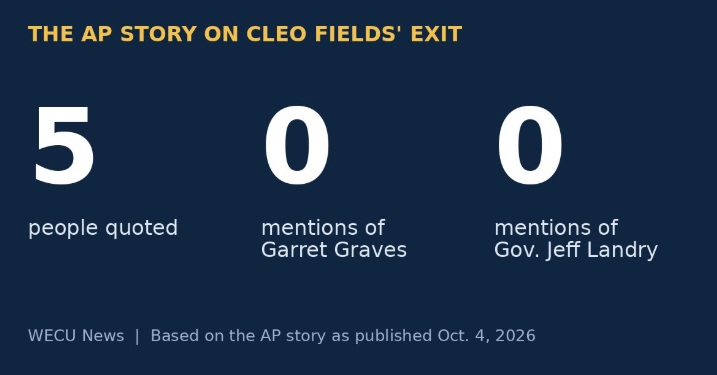
The AP Mourned One Baton Rouge Congressman's Exit. It Skipped the Other.
Analysis: An AP story quotes five people about Rep. Cleo Fields leaving Congress, and none from the other side. It never mentions the Republican who held the seat first.
By Lynn Matthews - October 6, 2026
The Associated Press story on Rep. Cleo Fields' exit from Congress quotes five people. Zero are Republicans. Zero voted for the new map, and zero work for the governor who signed it. It never mentions Garret Graves, who held the Baton Rouge seat before Fields did.
That leaves out half the story. East Baton Rouge lost two members of Congress in two years. In 2024, a new map turned Graves' district into a majority-Black district, and he chose not to run. "It is clear that running for Congress this year does not make sense," he said, and he called it a "temporary district." The AP tells the second exit and not the first.
The omission matters because of what the court later decided. In Louisiana v. Callais, the Supreme Court held 6-3 that the Voting Rights Act did not require that second majority-Black district, and that no compelling interest justified the state's use of race. When the Legislature passed the replacement map in May, the AP itself reported Republicans saying they "drew the lines solely based on partisanship, not race". That sentence does not appear in October's story, which describes only "the high court's conservative majority" striking the district. It does carry an activist's claim that the state is "back to where we were right after Reconstruction", with no response to it from anyone.
It also changes the question. The AP asks what Scotlandville loses without Fields, and Fields' own account is that the Louisiana Leadership Institute he founded in 1993 exists because he served in Congress. A fuller story would ask what each member delivered. Graves announced $575 million in reallocated federal money to finish the Comite flood project, championed the Pecue Lane interchange, and was a lead sponsor, with Rep. Abigail Spanberger, of the Social Security Fairness Act, which became law in January 2025. Fields has served in the House minority for under two years, which limits what any member could point to.