A viral claim from conservative commentator Benny Johnson says the U.S. military secretly dredged a brand-new shipping canal on the Omani side of the Strait of Hormuz, letting tankers “slip past Iran completely unseen.” The canal claim is false as stated. What actually happened is real, publicly confirmed, and considerably less dramatic — and Johnson appears to have dressed up a genuine, months-old news story as a secret engineering miracle.
Benny Johnson Claims US 'Secretly' Built New Strait of Hormuz. It Didn't.
Benny Johnson says the U.S. secretly dredged a new canal through Oman. His own map shows Panama, the underlying claim was self-hedged, and the real number he cites confirms a completely different, already-public operation.
By Lynn Matthews - August 30, 2026
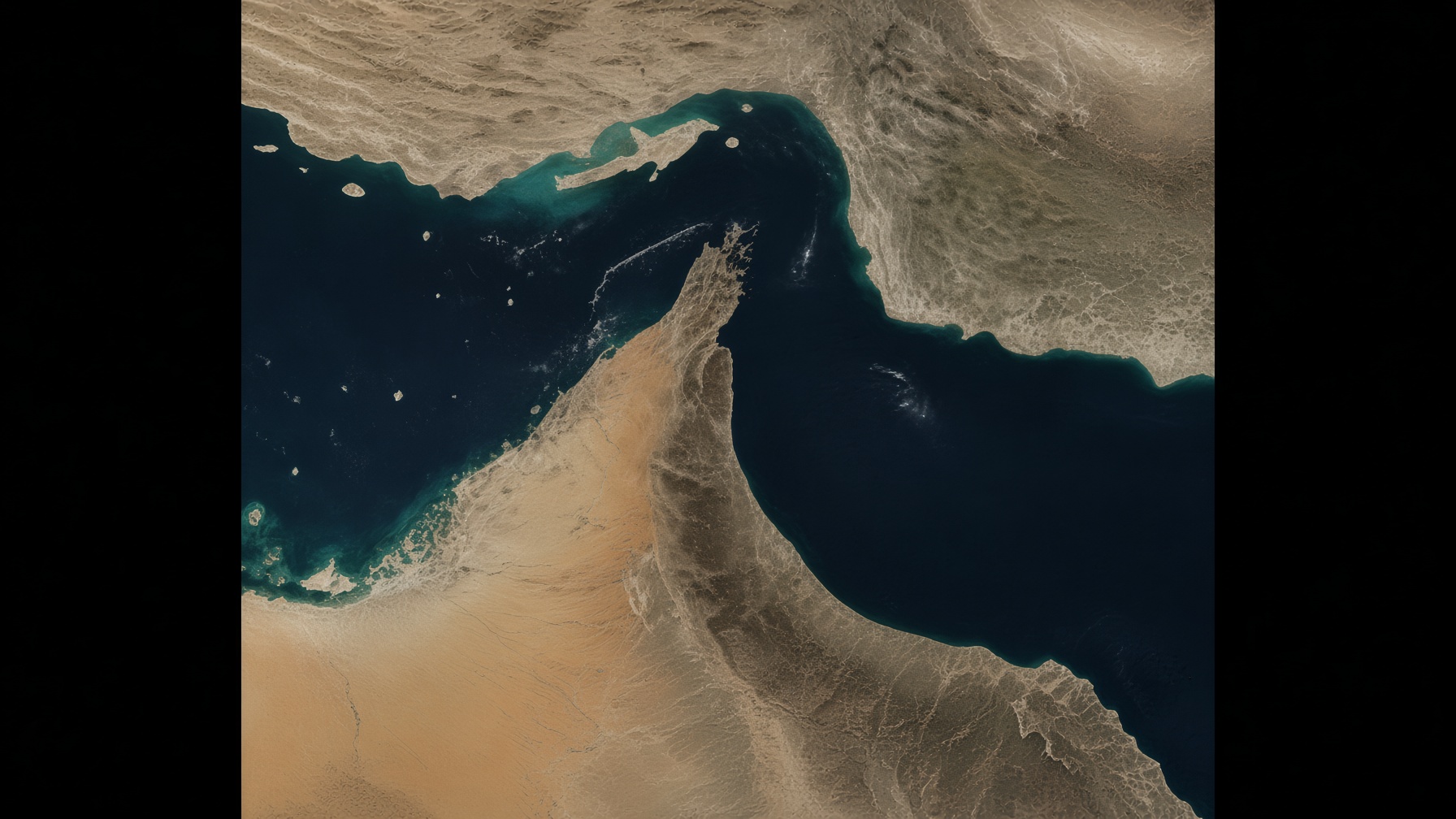
In an Aug. 29 post, Johnson wrote: “U.S. Military’s Most Secret Op REVEALED: Trump BUILT A New Strait of HORMUZ! Iran Enraged, ‘War OVER’... Satellite images show the U.S. military quietly dredged a new shipping lane on the Omani side of the Strait of Hormuz. Ships now slip past Iran completely unseen. That’s one of the reasons how the U.S. moved 750 million barrels of oil out of the Persian Gulf. Logistics beat missiles. Rome moved mountains. America moved the seafloor.”
U.S. Military's Most Secret Op REVEALED:
— Benny Johnson (@bennyjohnson) August 29, 2026
Trump BUILT A New Strait of HORMUZ! Iran
Enraged, War OVER...
Satellite images show the U.S. military quietly dredged a new shipping lane on the Omani side of the Strait of Hormuz.
Ships now slip past Iran completely unseen. That’s one… pic.twitter.com/y7EYqPJAkW
The video opens with the Panama Canal as a comparison — on camera, Johnson says it was “built by American might and engineering genius over a hundred years ago” — before pivoting to the Oman claim. Place names visible in that opening map, including Howard, Fort Kobbe and Playa Bonita, are Panama Canal Zone sites, not locations in Oman. The analogy itself is the point of that portion of the video, not proof that Johnson believed Hormuz was in Panama. But it does illustrate how loosely the visuals in the segment are being used to build a sense of scale and historical grandeur around a claim that, unlike the real Panama Canal, has never been confirmed to exist.
Where the underlying claim came from
Johnson’s post traces back to a smaller claim from a political commentary account called Morse Report, which posted on Aug. 28 that “recent satellite imagery suggests” a covert U.S. dredging operation had created a roughly 1,600-foot-wide shipping corridor on the Omani side of the strait — still geographically within the Hormuz region, not a full bypass of it. Even in its original form, the claim was explicitly hedged — “suggests,” not “confirms” — and multiple independent outlets that later covered the viral claim, including BusinessToday and MSN, reported that no White House, U.S. military, or Omani government source has confirmed any such operation.
No canal, trench, or new waterway through Omani land has been documented by any government, the International Maritime Organization, or major shipping-intelligence firm. Engineers who have studied the idea over the years point out the terrain problem: Oman’s Musandam Peninsula is steep limestone mountain, and a land canal there would require a Panama-style lock system on a scale nothing currently under construction resembles.
What actually happened — and it's real
Two things did genuinely occur, and both are a matter of public record, months before Johnson’s post.
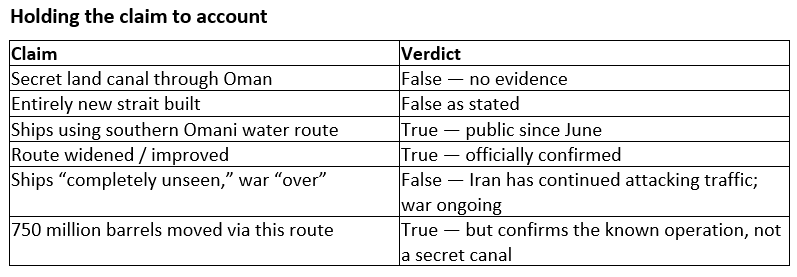
First, in late June, the U.S. Navy’s Joint Maritime Information Center — a real naval coordination body — officially announced it was expanding an existing water route near Oman’s coast to allow two-way tanker traffic, as a way to keep oil moving despite Iranian threats to the main shipping lanes. That is a real, on-the-record U.S. Navy statement about widening an existing route, not digging a new one.
Second, U.S. Central Command has separately and officially confirmed that Navy divers, SEALs, and supporting forces spent months clearing Iranian sea mines from Hormuz’s existing international shipping lanes, or traffic separation scheme — a genuine, dangerous, and successful military operation, announced on camera by Adm. Cooper. Some allied officials have privately expressed doubt that every mine has been cleared, according to Bloomberg reporting, though that uncertainty is about the thoroughness of the mine-clearing itself, not evidence of any separate dredging or canal project.
The 750 million barrels are real. They just don't mean what Johnson says they mean.
The 750-million-barrel figure in Johnson’s post is not invented. CENTCOM commander Adm. Brad Cooper said on camera that U.S. forces have protected the transit of roughly 1,500 commercial vessels and about 750 million barrels of crude oil over the past several months, using the existing southern channel along Oman’s coast — the same route the Navy announced it was expanding back in June, made safer by the mine-clearing operation. The White House has repeated the figure; NBC News reported it Aug. 27 as well. That is a real, significant, previously reported military and logistics success — though traffic through the strait remains far below the roughly 20 million barrels a day that moved through it before the war, and independent ship-tracking firms have at times put actual volumes lower than the figures U.S. officials cite. The 750 million barrels have nothing to do with a newly dredged canal. Johnson appears to have taken a genuine, confirmed number attached to one story and used it as “evidence” for a different, unconfirmed one.
Holding the claim to account
Why this matters
Real alternatives to the Strait of Hormuz do exist and are already in use: Saudi Arabia’s overland pipeline to the Red Sea, the UAE’s pipeline bypassing the strait entirely, and Omani ports like Duqm and Salalah that sit outside the chokepoint altogether. None of that required a secret canal, because the real workarounds were never secret — they were publicly announced, incremental, and considerably less cinematic than “Rome moved mountains. America moved the seafloor.”
Presenting a real, already-public military logistics success as a hidden engineering marvel — analogized to the Panama Canal, which actually was built — is the kind of claim that spreads fast precisely because it flatters the audience it’s aimed at. It also does something quieter and more corrosive: when the underlying war doesn’t actually end the way the claim implies, and the “secret canal” is never heard from again, audiences are left either confused or simply moved on to the next dramatic claim, with no accounting in between.
Sources:
Benny Johnson (@bennyjohnson), post on X, Aug. 29, 2026
Morse Report (@MorseReport), post on X, Aug. 28, 2026
BusinessToday, “Bypassing Strait of Hormuz? Viral post claims US dredged a new corridor on Omani side,” Aug. 29, 2026: https://www.businesstoday.in/world/story/bypassing-strait-of-hormuz-viral-post-claims-us-dredged-a-new-safe-corridor-on-omani-side-552046-2026-08-29
MS NOW (NBC News), “Trump says the Strait of Hormuz is open. But traffic is nowhere near what it used to be,” Aug. 27, 2026: https://www.ms.now/news/trump-strait-hormuz-iran-war-ships-cargo-oil
Associated Press (via Middle East Eye), “US Navy: Oman route through Hormuz expanding to facilitate traffic,” June 27, 2026: https://www.middleeasteye.net/live-blog/live-blog-update/us-navy-oman-route-through-hormuz-expanding-facilitate-traffic
Arab News, “A Gulf Suez Canal? Bypassing the Strait of Hormuz may be harder than its advocates suggest,” March 21, 2026: https://www.arabnews.com/node/2637185/amp
Al Jazeera, “How a 95 percent drop in Hormuz traffic changed global shipping,” Aug. 27, 2026: https://www.aljazeera.com/news/2026/8/27/how-a-95-percent-drop-in-hormuz-traffic-changed-global-shipping
Topics:Benny Johnson fact checkStrait of Hormuz canal claim falseMorse Report Oman dredgingCENTCOM 750 million barrelsUS Navy Oman route HormuzBenny Johnson Panama mapIran war Hormuz shipping fact checkJoint Maritime Information Center OmanHormuz secret canal debunkedmedia misinformation Hormuz
Have a correction or tip? See our corrections policy or contact the newsroom.
Comments
to join the discussion.
Loading comments...