Scientists building the next UN climate report dropped the most extreme emissions scenario, and President Trump says climate alarmism is over. Here is what changed and what did not.
By Lynn Matthews - November 24, 2026
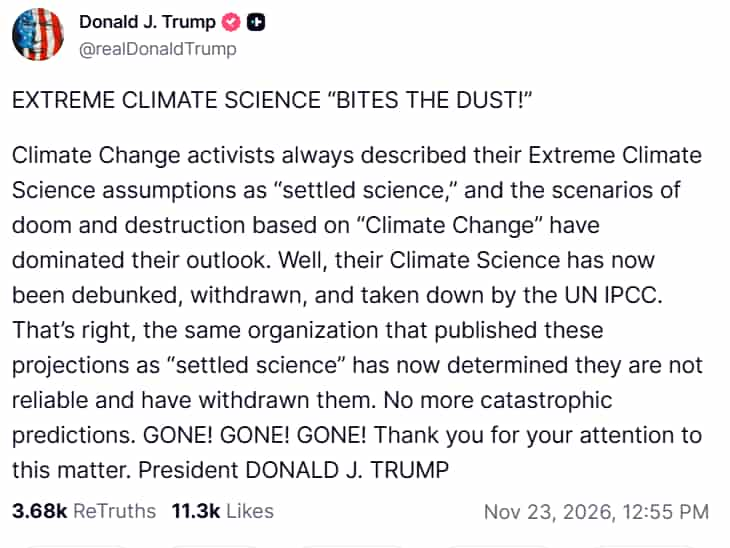
President Trump posted on Truth Social on Monday that "extreme climate science" "bites the dust," and that the UN climate panel has "debunked, withdrawn, and taken down" its own projections. The post follows a change by the scientists who build the emissions scenarios for the next major UN climate report. They have dropped the most extreme scenario, which assumed far more emissions than the world is on track to produce. The panel's core finding, that human activity is warming the planet, is not part of that change.
What the scenario was for
Climate models need an assumption about how much carbon the world will release, so scientists run them on a handful of "what if" storylines called scenarios. The most extreme one is known as RCP8.5, and its newer version is SSP5-8.5.
Researchers developed RCP8.5 in 2011 as a high-end test case. It was built to show roughly 5°C (9°F) of warming by 2100, and it became a staple of risk studies and headlines. Climate scientists Zeke Hausfather, Glen Peters and Piers Forster have written that it was "never a likely outcome even in a world that did not address climate change." See Eos. Modelers use a scenario like that the way an engineer uses a stress test.
Why the committee dropped it
A paper published in April in Geoscientific Model Development lays out the scenarios for the next round of climate modeling. Its authors wrote that the emissions levels in RCP8.5 and SSP5-8.5 "have become implausible." They pointed to falling renewable energy costs, new climate policies and recent emissions trends. The scenario assumed the world would burn far more coal than it does today and do almost nothing about it.
The replacement high-end pathway still reaches about 3.5°C (6.3°F) of warming by 2100. Another account says it reaches the old 5°C figure only around 2150. Andrew King, a climate scientist quoted by ScienceAlert, says the change does not show failed modeling and that climate action has made a measurable difference.
What changed and how it is described
Trump's post frames the change as the end of climate alarmism and says the UN panel has "withdrawn" the projections. The scenario researchers agree on one point: their paper calls the worst-case path "implausible." Published reporting describes the change more narrowly than the post does. The scenarios come from a scientific committee that designs inputs for climate models, and the changes are proposals for the panel's next assessment report. Eos does not say the panel has formally adopted them. None of the coverage describes a retraction of the panel's central finding that human activity is driving warming.
Supporters of his view point to public warnings that went well beyond the science. In January 2019, Rep. Alexandria Ocasio-Cortez told an audience in New York that "the world is gonna end in 12 years" if the country did not address climate change. Her timeline likely drew on a 2018 UN report about the 1.5°C limit, and that report does not say the world will end. She later said Republicans were taking her "dry humor" literally.
The effect on young people has been measured. A 2021 survey of 10,000 people aged 16 to 25 in ten countries found that 59% were very or extremely worried about climate change. More than 45% said those feelings affected their daily lives. The authors link the distress to young people's view that governments are not doing enough, and they note the survey shows an association, not a cause.
The change is also months old. Eos reports that Trump first welcomed it on May 17 with the words "GOOD RIDDANCE." Monday's post returns to the subject.
What it means for the warming forecast
Dropping the worst case lowers the top of the range. It also removes the other end. The best scenario, the one that kept the Paris goal of 1.5°C within reach, was retired too. The best remaining pathway overshoots 1.5°C, peaking around 1.7 to 1.8°C before it declines. Current global policies point toward as much as 3°C by 2100.
Detlef van Vuuren, who leads the committee that designs the scenarios, told E&E News that "we are in a much worse situation than we were in 15 years ago". Jennifer Morris, an MIT energy modeler, compares a worst-case scenario to insurance, which covers extreme outcomes rather than likely ones.
Eos adds a caveat. Global emissions are still rising. The new scenarios assume they climb more slowly than the old worst case did. The practical effect is that the most dramatic numbers will appear less often in future reports. The argument over how much warming is likely, and which policies fit, goes on.