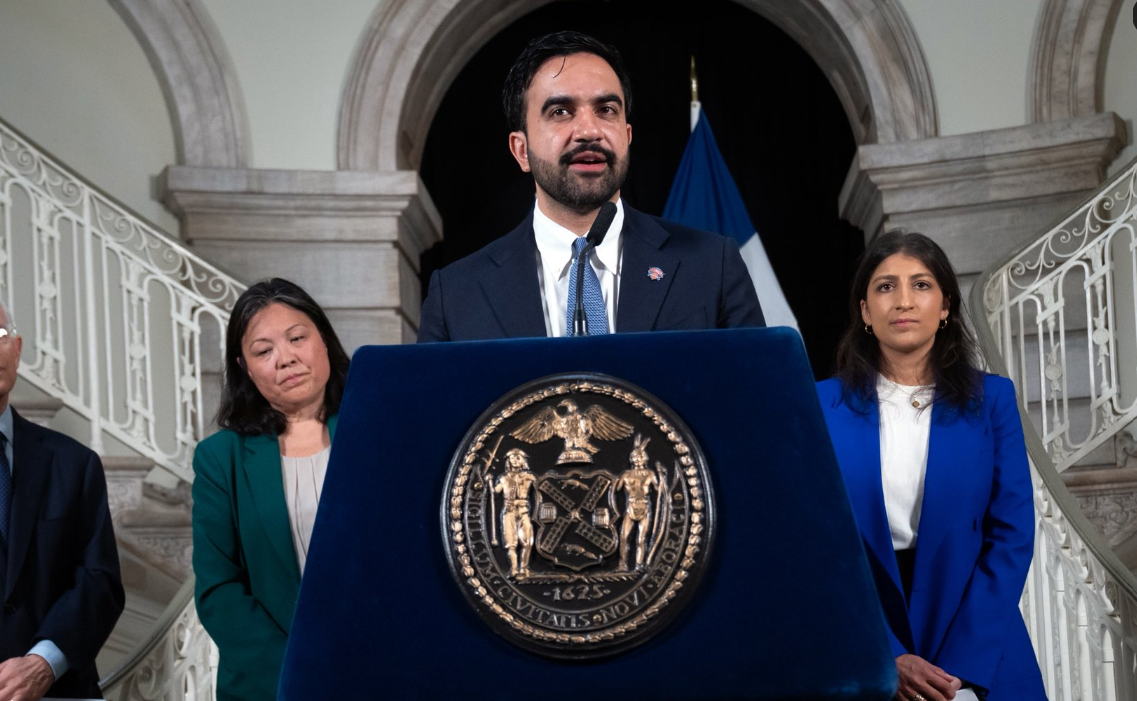
Calls to strip the NYC mayor's citizenship have real legal machinery behind them — a DOJ memo, a formal complaint, and no statute of limitations. Whether the case actually holds up is a separate question, and legal experts across the spectrum are skeptical.
Since Zohran Mamdani's rise to New York City mayor, calls to revoke his citizenship have gone from online chatter to an actual formal request to the Justice Department. Whether that request has real legal legs depends on a few specific, narrow questions — not general opinions about Mamdani's politics.
What's Actually Been Filed
In June, Rep. Andy Ogles sent a letter to Attorney General Pam Bondi asking the DOJ to pursue denaturalization proceedings against Mamdani. The letter rests on two claims: that Mamdani wrote rap lyrics in 2017 referencing the "Holy Land Five" — men convicted in 2008 of funneling money to Hamas through a Muslim charity — and that he failed to disclose his membership in the Democratic Socialists of America on his 2018 citizenship application, Form N-400.
This isn't happening in a vacuum. In June, the DOJ's Civil Division issued internal guidance directing attorneys to prioritize denaturalization cases more broadly than in past administrations, reportedly asking USCIS field offices to refer 100-200 cases per month for review.
Question 1: Did He Actually Misrepresent Himself?
The case FOR: Form N-400 asks applicants to list memberships in organizations. If Mamdani was a DSA member at the time he filed in 2018 and didn't list it, that's a factual omission on a sworn federal form. Denaturalization advocates argue this, combined with his later public embrace of DSA and past statements, shows a pattern of concealment about his political affiliations at the time citizenship was granted.
The case AGAINST: Omitting a lawful political organization isn't automatically fraud — the law requires the government prove the omission was material: that disclosing it would have actually changed the outcome. DSA is a legal U.S. political party-adjacent organization, not the Communist Party USA, which is the specific group Congress named as disqualifying under 8 U.S.C. § 1424. Multiple immigration attorneys quoted across NBC, Time, and the Brennan Center say DSA membership alone likely wouldn't have blocked his naturalization even if fully disclosed — meaning it may not clear the materiality bar regardless of what was or wasn't on the form. Separately, the rap lyrics predate the application but are political speech, not a statement made on the form itself, and several lawyers have called that evidence "hearsay" and thin.
The honest answer, factually: whether Mamdani was already a DSA member in 2018, specifically, isn't something WECU News found clearly confirmed in public reporting. He's consistently described as a "longtime" DSA activist, but a precise join date isn't well-documented publicly — which matters, because if his DSA involvement began after 2018, the entire misrepresentation claim collapses on the facts alone, regardless of the legal standard.
Question 2: Is There a Time Limit?
This is where it gets genuinely surprising: for the route the Trump DOJ actually prefers — civil denaturalization under 8 U.S.C. § 1451(a) — there is no statute of limitations at all. Courts have explicitly rejected arguments that a time limit should apply; in one 2019 federal appeals case, a man denaturalized seven years after receiving citizenship argued the case came too late, and the court disagreed, upholding that civil denaturalization can be pursued decades later if the government chooses to. The only time limit in this area applies to the separate criminal route (18 U.S.C. § 1425), which does carry a 10-year statute of limitations — but that route also requires a full criminal conviction, a jury, appointed counsel, and proof beyond a reasonable doubt, a far higher bar than the civil process.
So if there's a timing problem here, it isn't a legal deadline that's expired — Mamdani naturalized in 2018, well within any window that would matter. The real timing question is the factual one above: whether the underlying DSA membership existed when the form was filed, not whether too much time has passed since.
What Legal Experts Actually Think
Across the political spectrum, legal experts have been notably unified in skepticism. Michael Kagan, a law professor at the University of Nevada, Las Vegas, told Al Jazeera that denaturalization "is limited to cases where the government can prove material fraud in their original applications" — and that bar is rarely met. The Brennan Center for Justice has pointed to a line of Supreme Court cases, starting with Afroyim v. Rusk (1967), limiting the government's ability to use denaturalization as a tool against people for their political views rather than genuine application fraud. The Supreme Court's 2017 decision in Maslenjak v. United States further tightened the standard, requiring that any false statement actually "played a role" in the citizenship decision — not just that it was left out.
If Mamdani were denaturalized, his status would revert to lawful permanent resident — which would legally disqualify him from serving as mayor. That's the real stake behind the fight, and exactly why immigration lawyers on both sides are watching this case closely, whatever they think of its merits.
The Strongest Version of the Case Against Him — and Why It Still Falls Short
Strip away the rhetoric from the harshest opinion pieces circulating on this, and the actual argument for denaturalization tends to rest on a few specific claims. It's worth engaging with the strongest version of each, not a caricature of it.
Claim: His open embrace of Marxist rhetoric proves his naturalization oath — attachment to the Constitution — was never sincere. This is the closest thing to a real legal argument in the mix, and it has direct Supreme Court precedent against it. In Schneiderman v. United States (1943), the government tried to denaturalize a man who was an actual, self-avowed Communist Party member — not DSA-adjacent, an actual party member — on precisely this theory. The Supreme Court rejected it, 5-3, holding that mere belief in or advocacy of socialist or communist principles, without advocating present, actual violence to overthrow the government, does not establish a lack of constitutional attachment. The Court went further, holding that any doubt in a denaturalization case must be resolved in favor of the citizen, not the government. Quoting Marx or praising a foreign socialist mayor is closer to the exact conduct Schneiderman already tested — and lost on, for the government's side.
Claim: He hosted Mahmoud Khalil, someone accused of terror sympathies, which shows his true loyalties. As covered above: this happened in 2026, eight years after his 2018 naturalization. Whatever it says about his judgment as mayor, it's conduct after the fact, not a false statement on the application itself — the only thing denaturalization law actually examines.
Claim: He lied about his race on a 2009 Columbia application, so he likely lied on his citizenship application too. This is an inference stacked on an inference — a different form, nine years earlier, for a different purpose, with no evidence connecting it to what he actually wrote on his N-400. It's a suspicion, not a documented finding.
None of this means Mamdani's politics, his choice of dinner guests, or his past aren't fair game for scrutiny and criticism — they clearly are, and WECU News has covered all three. It means denaturalization specifically is a narrow legal tool, not a catch-all remedy for a mayor's opponents finding him alarming. The Supreme Court has already weighed a case built on almost exactly this argument, decades ago, and came down on the side of the citizen.
There's a real, formal complaint. There's no legal deadline standing in its way. But "legally possible to file" and "legally likely to succeed" are different things — and on the actual evidence made public so far, the weight of expert legal opinion, including from lawyers with no obvious sympathy for Mamdani politically, leans toward this not meeting the fraud-and-materiality standard the Supreme Court has set. Whether that changes depends entirely on what, if anything, the DOJ turns up that hasn't been made public yet.
Sources:
PolitiFact/Poynter — Why efforts to revoke Mamdani's citizenship are unlikely to succeed
NBC News — Calls to strip Mamdani's citizenship spark alarm about denaturalization
TIME — Can Trump Deport U.S. Citizens Like Musk and Mamdani?
Brennan Center for Justice — How the Supreme Court Rejected Denaturalization as a Political Weapon
Congressional Research Service — Denaturalization: A Brief Overview of the Current Legal Framework
America First Policy Institute — Denaturalization Primer
Have a correction or tip? See our
corrections policy or contact the newsroom.