A common claim making the rounds is that the internet and smartphones ran for decades without data centers, and that this current wave is something entirely unprecedented. That misses the history. What's actually new isn't the existence of data centers — it's their size, speed, and concentration.
Data Centers Aren't New. The Scale Is.
The internet has run on data centers since before most of us were born. What's actually new is how fast, how big, and how concentrated the current buildout is — and who's left holding the bill.
By Lynn Matthews - September 2, 2026
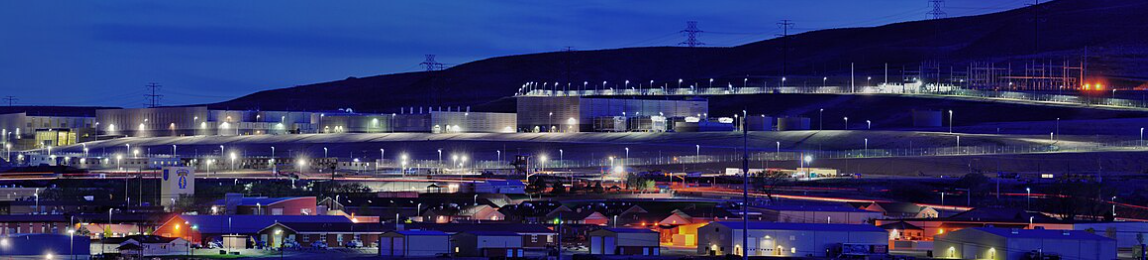
Dedicated computing rooms date back to the mainframe era of the 1950s and 1960s, when businesses and universities built entire climate-controlled rooms just to house room-sized computers. Commercial data center facilities and colocation — renting out server space and connectivity to multiple companies under one roof — expanded alongside the public internet in the 1990s, as companies needed always-on connectivity, web hosting, and shared server infrastructure rather than running their own in-house server closets.
Smartphones, when they arrived, sat on top of that same backbone. Every app, every map, every photo backup — and now every AI model response — lives on clustered machines somewhere that need power, cooling, and fiber connectivity to run. The internet was never "data-center free." It's been data centers, at some scale, the entire time.
What actually changed: size and speed
The United States already has several thousand operational data centers. One current tracker, dcmap.us, counted 3,359 operational U.S. facilities as of August 2026. The same database lists 4,779 current facilities and projects when under-construction and planned sites are folded in. On that broader, pipeline-inclusive list, Texas leads with 606 records, followed by Virginia (477) and California (355) — about 30% of everything tracked nationally. Operational leadership still clusters in the same core states; it's the pipeline of what's still being built that has pushed Texas to the top of the combined count.
The pipeline behind that number is substantial in its own right: the same tracker puts unfinished, announced power in the planned-and-under-construction pipeline at roughly 319 gigawatts. Not every announcement will actually get built — interconnection delays, transformer shortages, water availability, and local opposition are already thinning the list before shovels hit the ground. Even accounting for that drop-off, the current buildout is being driven harder by AI training and inference than by the cloud or enterprise workloads that built out most of that earlier 3,359-facility base — AI packs far more electricity demand into fewer, denser sites than the data centers of even five years ago.
The pitch versus the pushback
Supporters, President Trump prominent among them, frame the buildout as jobs, tax base, and a contest with China. He's warned that "if we kill the Golden Goose, you will only have yourselves to blame," and said communities turning projects away are choosing to be "backwards and poor." Separately, in comments about Texas's pushback, he said data centers "could be bigger than oil." The administration has also pushed faster permitting for on-site power generation so large campuses aren't stuck waiting years for grid interconnection.
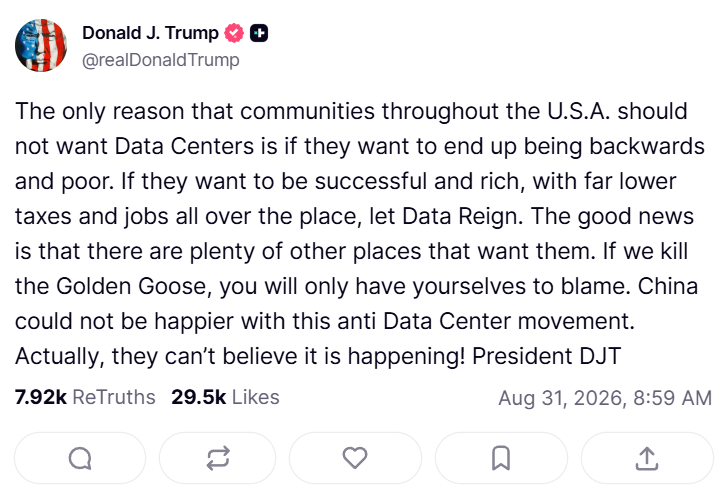
That pitch collides directly with local costs. Residents and farm groups point to water use for cooling in drought-stressed basins, strain on transmission and generation capacity, higher electricity rates for households and irrigators, and the conversion of farmland to industrial use. New York enacted the country's first statewide moratorium on new hyperscale data center permits this year — applying to large facilities generally consuming 50 megawatts of power or more, not smaller server rooms — a pause of up to one year on state environmental permits while the state develops a uniform environmental impact standard, a community-benefits framework covering things like infrastructure and workforce investment, and possibly a grid-modernization fund data centers would have to pay into. Other states and counties have tightened rules or paused approvals of their own rather than going as far as a full statewide halt. Opposition tends to run strongest exactly where the benefits look national, and the burdens look local — a few hundred megawatts drawn from an aquifer or a rural substation that one town has to live next to.
Both things are true at once
The honest picture is both/and, not either/or. The internet was never data-center-free — this technology has quietly underpinned nearly everything online since the 1990s, and computing rooms predate even that. What's genuinely different about the current wave is that the power, water, and land demands are more concentrated, moving faster, and far more politically visible than anything in the industry's earlier decades. Whether the United States can add this much capacity without simply exporting the bill to whichever town happens to be nearest the substation is the part of this story that's still being written.
Sources:
Fortune, "Trump Calls Data Center Opponents 'Backwards and Poor' as the Industry Props Up the Economy" (Sept. 1, 2026)
Yahoo Finance, "Trump Says Data Centers Could Be Bigger Than Oil"
Office of Governor Kathy Hochul, "First Statewide Moratorium on New Hyperscale Data Centers Launched"
Topics:how many data centers in the USdata center history mainframedata center moratorium New YorkTrump data centers golden goosedata centers bigger than oildata center backlash 2026
Have a correction or tip? See our corrections policy or contact the newsroom.
Comments
to join the discussion.
Loading comments...