October 13, 2026
TECH HISTORY
A fun look at the gadgets that taught a generation patience, from the undertaker who built the dial to the phone in your pocket.
October 13, 2026
TECH HISTORY
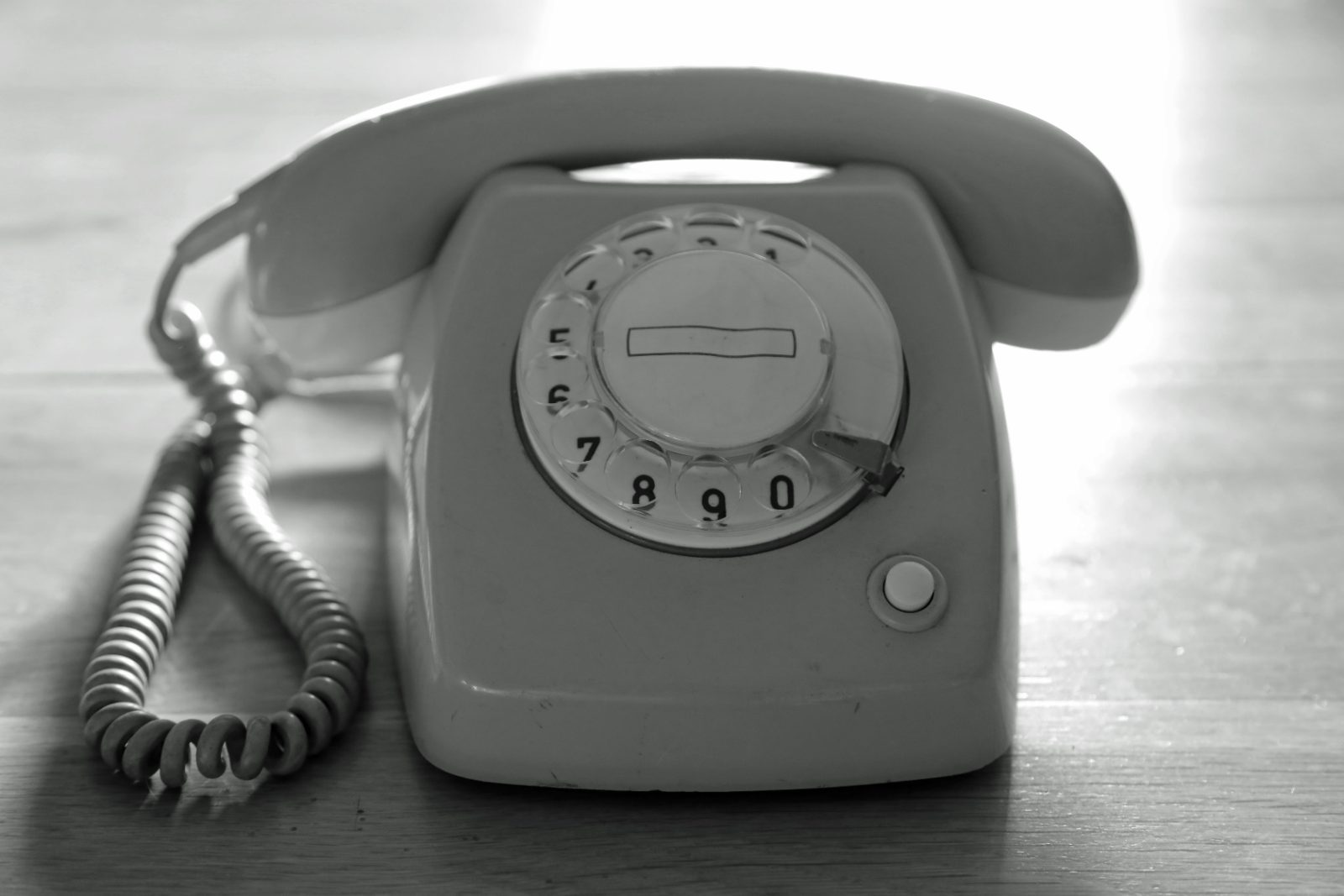
Ask a teenager what a dial tone was for and you may get a polite blink. Ask what a phone cord did and the answer might be that it kept the phone from wandering off. A phone you could not carry and a computer that sang to a phone line to get online were both ordinary within living memory. Here is how we got from there to here.
The automatic telephone began with a grudge. In 1891, Almon Strowger, a Kansas City undertaker with no technical training, patented an automatic switch because he believed the operators were steering his customers to a competitor. His cure was to remove the operators. The first Strowger system went into LaPorte, Indiana, in 1892.
The dial took a while to reach everyone. Bell began replacing human switchboards in 1919, one exchange at a time, and nearly every exchange had converted four decades later. Bell even showed short films in movie theaters to teach people how to use it. Phone numbers began with an exchange name, so "Pennsylvania 6-5000" was dialed as PE 6-5000. The letters above the digits skipped Q and Z, and zero was kept for the operator.
Because the dial worked by sending quick pulses down the line, some especially nimble callers discovered they could tap the hook switch fast enough to dial a number without touching the dial at all. It was a party trick with a short audience.
Touch-Tone debuted in November 1963 as a premium service that cost $1.50 extra per month. Bell Labs psychologist John Karlin led the research behind the keypad, which put 1-2-3 across the top row. Accountants objected because calculators used a different arrangement, and AT&T answered that calculators had no letters. The layout stuck, and it now appears on ATMs and gas pumps. Bell Labs staff even preferred to call the # key the "octothorp," though most of us still say "pound."
Television was learning to see in color. The FCC adopted a color standard in December 1953, yet only about 10 percent of American homes had a color set by 1965. CBS had tried regular color broadcasts in New York in 1951 and stopped after four months because so few homes had receivers. The black-and-white set stayed on the living room shelf for years, and the dial on the front of it was how you changed the channel.
The first commercial modem, AT&T's Bell 103, arrived in 1962 and ran at 300 bits per second over the same wires that carried voices. Decades later, the same idea screeched through millions of homes. One writer described the sound as a computer "almost literally talking to a remote computer" over a phone line, and noted that users learned to read the noises the way old farmers judge a harvest. Going online also tied up the family phone, so anyone who picked up the receiver at the wrong moment knocked the whole household offline.
In 1993, AOL's marketing chief proposed mailing free trial discs to get people online. They turned up in cereal boxes and on fast-food trays, and at one point an estimated half of all CDs produced carried the AOL logo. AOL had fewer than 200,000 subscribers when it went public in 1992, according to former CEO Steve Case, and about 25 million a decade later. The discs have since become collectibles, and the Smithsonian has displayed them.
The web itself came out of a physics lab. Tim Berners-Lee drafted the proposal at CERN in 1989, and the first website went live in December 1990. On April 30, 1993, CERN placed the web software in the public domain, which let anyone build on it for free. A year later, Marc Andreessen and Jim Clark built Netscape, a faster rewrite of the Mosaic browser whose personal copies were free. Netscape's 1995 IPO is credited with launching the dot-com boom. Microsoft then shipped Internet Explorer free with Windows 95, and by 1998 Explorer had overtaken Netscape. Part of Netscape lives on today as Firefox.
Google arrived in September 1998, and its first office was a garage in Menlo Park, California, founded by Larry Page and Sergey Brin.
On January 9, 2007, Steve Jobs unveiled the iPhone at Macworld in San Francisco, calling it a "revolutionary and magical product." It went on sale June 29, 2007, at $499 for the 4GB model. It combined a phone, a music player, a camera and a web browser in a device that weighed 4.8 ounces.
The gadgets keep getting smaller and chattier. People now ask chatbots questions out loud and get an answer back in seconds, something a rotary-dial household would have filed under science fiction. Nobody can say for sure what the next jump will look like, which is the one thing it has in common with every earlier jump.
Hand a teenager a rotary phone and watch them hunt for the button. It takes about a minute to explain, and then comes the real question: what will they hand to their own kids that makes them blink?
Sources:
EBSCO Research Starters: Strowger Patents Automatic Dial Telephone System
Engineering and Technology History Wiki: Telephone Dials
History of Information: The Bell System Introduces "Touch-Tone" Dialing
Museum of Broadcast Communications: Color Television
Computing History (UK): The first commercial modem is manufactured
Quartz: Dial-up internet was defined by a distinct sound
Mental Floss: You've Got Mail, a history of AOL's free trial CDs (Oct. 14, 2016)
Computer History Museum: Browser Wars
Go Historic: Google's first headquarters, Menlo Park, California
History.com: Steve Jobs debuts the iPhone (Jan. 9, 2007)
Loading comments...