Purpose Of This Paper
This paper treats missing U.S. refining capacity, not crude production, as the binding constraint on fuel autonomy. It proposes a Gulf light-crude buildout, a first-fill product rule, and a permitting clock. It rejects a standing ban on diesel exports.
1. Findings
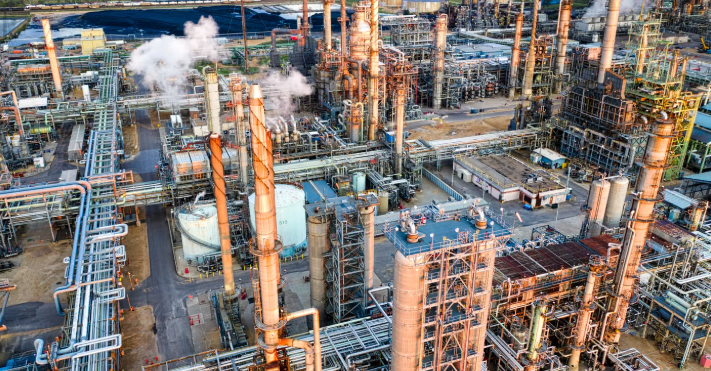
The United States has a factory problem, not a crude problem. The country can produce oil at superpower scale. It cannot, at the scale a market this size should, turn that oil into gasoline, diesel, and jet fuel here and hold finished product in American tanks. That missing middle is why a Midwest driver can watch a Hormuz closure and a Rotterdam distillate bid print on the same pump.
The refining fleet is tight and shrinking. EIA counted 130 operable refineries and about 18.2 million barrels per calendar day of atmospheric distillation on January 1, 2026, down more than 250,000 b/d from a year earlier after the LyondellBasell Houston and Phillips 66 Los Angeles closures. Utilization has run in the mid- to high-90s for long stretches of 2026. Spare stills are effectively gone. When a Midwest unit trips, a West Coast plant closes, or a strait is contested, the shock has nowhere to go except price.
Greenfield capacity has been a generational event. The last large Gulf refinery of consequence dates to the 1970s. Later “new” plants are small or specialty; most added barrels came from expansions at existing sites because a new plant is a permitting career, not a construction schedule.
The odd trade pattern is configuration, not mystery. Gasoline and diesel leave the same barrel. U.S. plants make more diesel than the domestic market burns. Without enough capacity and storage reserved for U.S. cover, that diesel leaves. Many Gulf units were built for heavy, sour imported crude. Shale is light and sweet. The system therefore exports light domestic crude and still imports heavy foreign crude. That is a factory built for a different decade.
Gasoline imports are regional logistics, not proof the country cannot make gasoline. Inbound gasoline and blendstock still concentrate on the East Coast (PADD 1) and, after California closures, the West Coast. National net trade in products can look fine while New York Harbor and Los Angeles remain exposed.
2. Why a diesel-export ban fails the goal
A standing ban traps surplus distillate in PADD 3. Storage fills. Runs get cut. Gasoline and jet fuel fall with diesel. Wood Mackenzie estimates crude run cuts of over 2 million b/d would be required to keep inventories from exceeding storage capacity under a ban, with a large associated drop in gasoline output. That is how a policy aimed at the pump raises the gasoline price. Surplus diesel should move after U.S. tanks are inside a safe band, not as the thing we outlaw in order to feel autonomous.
3. Policy design
Goal (illustrative, to be scored by EIA/DOE): replace lost coastal distillation and add dedicated light tight oil capacity on the Gulf; hold a published days-of-cover band for finished gasoline and distillate in PADD 1 and PADD 5; cut U.S. pass-through from global product shocks. This is not a political price decree. It is spare stills plus inventory.
Instrument A — Permitting clock (keep limits, kill delay)
A greenfield or major expansion refinery should have one federal lead agency where a federal hook exists, concurrent air, water, and NEPA-equivalent review, a firm EIS/EA clock, a short statute of limitations on legal challenges, and remand with a deadline rather than automatic vacatur. The 150-day judicial review window used in both the SPEED Act and the Energy Permitting Reform Act is the leading example on the table in Congress, against a current default of six years under the Administrative Procedure Act. Numeric emissions, flare, and benzene standards stay. Six-year injunction fog goes. Time and certainty are the product, not a license to poison a town.
Instrument B — First-fill, not an export panic button
Stand up or expand a regional product reserve (gasoline and ultra-low-sulfur diesel) sized to PADD 1 and PADD 5 winter and summer peaks, filled in slack months. Any plant that takes accelerated federal permitting or public credit should carry a priority offtake clause for domestic rack customers when regional stocks are below the published band. Below-band weeks trigger public reporting of export fixtures from the affected PADD. Licensing is a last-step shortage tool, not the standing regime. American tanks fill first. Surplus takes the world price.
Instrument C — Gulf light-crude buildout
New stills should be designed for Permian and other light tight oil: crude unit plus the downstream kit that actually yields gasoline and jet for U.S. spec (alkylation, reforming, hydrotreating), not a diesel-max export machine. Pair plants with a Permian-to-Gulf crude line that exists in steel, not slides, and with product movement that can reach PADD 1 without treating the Jones Act as an afterthought.