The Empty Porch: Pride in America Hits a Record Low
Only 43 percent of Americans display a flag at home, and just 33 percent say they are extremely proud, the lowest Gallup has recorded.
Only 43 percent of Americans display a flag at home, and just 33 percent say they are extremely proud, the lowest Gallup has recorded.
The Empty Porch: Pride in America Hits a Record Low
Only 43 percent of Americans display a flag at home, and just 33 percent say they are extremely proud, the lowest Gallup has recorded.
By Lynn Matthews
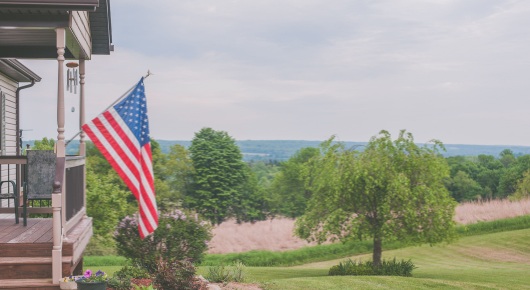
There are porches in this country that used to carry a flag and don’t anymore. For some of them, the people inside still love the place. They have learned, somewhere along the way, that flying the flag can cost them a friend or an easy conversation. Gallup says only 43 percent of Americans now display one outside the home, down from 59 percent in 1991, in the glow of the Gulf War victory. The number feels small until you picture the street. More than half the houses have no flag out front, and the wind moves through empty air where the cloth used to speak.
The same quiet runs through the newest pride numbers. This June, only 33 percent of Americans told Gallup they are extremely proud to be American, the lowest reading since the question was first asked in 2001, when it stood at 55 percent. Add those who say they are “very proud” and you still reach only a little over half the country. Among adults ages 18 to 34, the figure collapses to 14 percent. Women sit at 26 percent, men at 42 percent. Republicans remain the outlier at 70 percent; independents and Democrats have fallen to 28 and 14. Gallup does not tell us why. It simply records the silence.
For a long stretch of American life, pride did not need a speech. It lived in the shift change and the tool chest. Manufacturing employment peaked in June 1979 at 19.6 million jobs. By June 2019 it stood at 12.8 million. The work that once let a man or woman point to a finished thing and say “I made that” thinned out over those decades, and the pride numbers have slid since the early 2000s. No one claims the factory floor alone explains the drop. Still, something ordinary left with those jobs: the daily proof that the country could still make its own way.
Then there is the other proof, older and sharper. Two hundred and fifty years ago this past summer, the Declaration of Independence ended with a line that still catches the breath: “we mutually pledge to each other our Lives, our Fortunes and our sacred Honor.” The men who signed it were naming the price, and to the Crown the act was treason. The popular stories of ruined estates and hunted men are mostly legend, but the narrower record is enough. The British captured Richard Stockton, and his health never recovered. Two of Abraham Clark’s sons were held on a prison ship, and John Witherspoon’s son died at Germantown. They signed anyway. They handed the future a document the Crown called a crime, and some of them paid for it in the war that followed.
That is the inheritance the empty porch leaves unclaimed: a country that began by risking everything on the claim that ordinary people possess rights no king can cancel, and that has spent two and a half centuries arguing, imperfectly, about what that claim requires. The argument has always been loud. The pride used to be quieter, more ordinary, less in need of defense.
If you already feel it, you know the hesitation. You know the pause before you hang the flag and the calculation before you say the word out loud in certain rooms. The numbers suggest you are not alone in the pause. The pause has a cost. A nation that grows ashamed of its own better moments gets smaller, and nothing about that makes it more just. The people who still carry the pride keep the larger story from shrinking into a list of grievances. They remember a father’s lunch pail and a grandmother’s quiet tears on Memorial Day, and they still feel the simple shock of standing on free ground.
So hang it if you still want to. Say the sentence if it is still true in your chest. Do it without turning it into a challenge to anyone else, and without claiming everything has always been right. Do it the way the signers made their pledge, as a promise that costs something and is worth the cost. The country they risked everything for is still here. So are you. And somewhere on a street that has gone quieter than it used to be, one more flag in the wind is not a small thing.
It is the answer to the question Gallup keeps asking. It is also the answer the empty porch is waiting to hear.
Sources:
• Gallup, “American Pride Falls to 25-Year Record Low” (June 29, 2026)
• Gallup, topline and tabs for the June 1-15, 2026 poll (flag display, 1991 and 2026)
• Bureau of Labor Statistics, “Forty years of falling manufacturing employment”
• National Archives, Declaration of Independence transcript
• National Park Service, “An Act of Treason” (Signer’s Island exhibit)
• Rosenbach, “Collecting Signers of the Declaration: New Jersey”
• National Park Service, John Witherspoon biography
History News Network, “The Myth About the Signers of the Declaration of Independence that Won’t Die”
Loading comments...