Fact-Check: Does Louisiana Actually Authorize Flock Cameras? LACAG Says No — Here's What We Verified
Viral post claims Louisiana police lack authority for Flock cameras. WECU News checks the law.
By Lynn Matthews - August 19, 2026
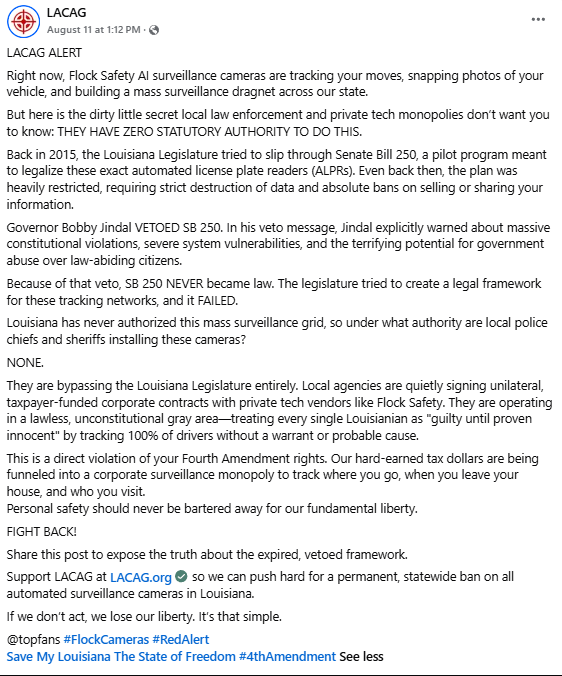
The Post
The Louisiana Accountability Coalition Action Group (LACAG) posted an alert on Facebook this month arguing that Flock Safety's automated license plate reader (ALPR) cameras are operating in Louisiana with no legal authorization at all. LACAG granted WECU News permission to reprint the post. It's embedded below in full, exactly as published.
What WECU News Verified
We went to the Louisiana Legislature's own bill-tracking system and the current Louisiana Revised Statutes to check LACAG's claims against the primary record, rather than take the post at its word. Here's what holds up, what needs more precision, and what's still a live legal argument rather than settled fact.
Claim: SB 250 passed the Legislature in 2015 and was vetoed by Gov. Jindal
VERIFIED.Senate Bill 250, sponsored by Sen. Ronnie Johns, passed the Louisiana Senate 33-3 and the House 83-13 in the 2015 Regular Session. It would have created the Statewide Motor Vehicle Theft and Uninsured Motorists Identification Program, a pilot ALPR framework with data-retention limits and restrictions on sharing captured plate data with outside entities. Gov. Bobby Jindal vetoed the bill, writing that programs like it “pose a fundamental risk to personal privacy” because captured data would be accessible to private entities regardless of whether any violation was detected.
Claim: Louisiana has never authorized this mass surveillance grid.
VERIFIED, AND STILL TRUE TODAY. A near-identical successor bill, Senate Bill 54, was introduced in the 2016 Regular Session and also failed to become law. Both bills would have created Revised Statute 32:46 to govern ALPR use. That statute does not exist in Louisiana's current code — we checked Title 32 directly. No Louisiana law has ever been enacted to authorize, regulate, or place guardrails on ALPR or Flock-style camera networks.
Claim: They have zero statutory authority to do this.
ACCURATE, BUT NEEDS ONE IMPORTANT DISTINCTION LACAG DOESN'T SPELL OUT. It's true there is no statute authorizing local police to run ALPR networks. But there is also no statute prohibiting it. Local law enforcement agencies generally operate under broad “general police power,” which lets them adopt tools and tactics on their own authority unless a law specifically forbids it — not the reverse. That means Dearborn-style Flock deployments in Louisiana aren't illegal in the sense of violating a specific statute; they're unregulated, operating with no statewide standard for data retention, sharing, audits, or oversight, because the one bill that would have created those guardrails was vetoed and never replaced. That's a real accountability gap. It's a different, more precise claim than “breaking the law,” and the more precise version is also the more damning one: nobody in Louisiana's state government has set any rules for this at all.
Claim: This is a direct violation of your Fourth Amendment rights
THIS IS A LEGAL ARGUMENT, NOT AN ESTABLISHED FACT — and it's the same unsettled question WECU News has been tracking across our Flock coverage. Courts are actively split: a federal judge ruled for the City of Norfolk in the closely watched Schmidt v. City of Norfolk case in January, and that ruling is now on appeal to the 4th Circuit. The Institute for Justice has an active lawsuit arguing warrantless Flock use is unconstitutional. The Supreme Court's recent Chatrie v. United States ruling on geofence data could reshape how courts view ALPR searches going forward, but didn't address license plate readers directly. LACAG is making a real, serious constitutional argument that a growing, bipartisan list of lawmakers and legal advocates share — but it's still being litigated, not decided.
The Bottom Line
LACAG's core factual claim checks out: Louisiana's Legislature tried once to build a legal framework for ALPR cameras; that attempt was vetoed a decade ago, and nothing has replaced it since. Every Flock camera currently operating in Louisiana does so with zero statewide rules governing how long your data is kept, who it's shared with, or how it's audited. Whether that also makes it a Fourth Amendment violation is a question still working through the courts — one WECU News will keep covering as it develops.