Federal Order Declares the Era of "Super Intelligence"
Executive Order 14434 directs agencies to call today's AI "Super Intelligence" and "SI." In AI research, that term describes a system that greatly exceeds the best human minds across virtually every domain. The order treats the two as equivalent.
By Lynn Matthews - October 12, 2026
ANALYSIS
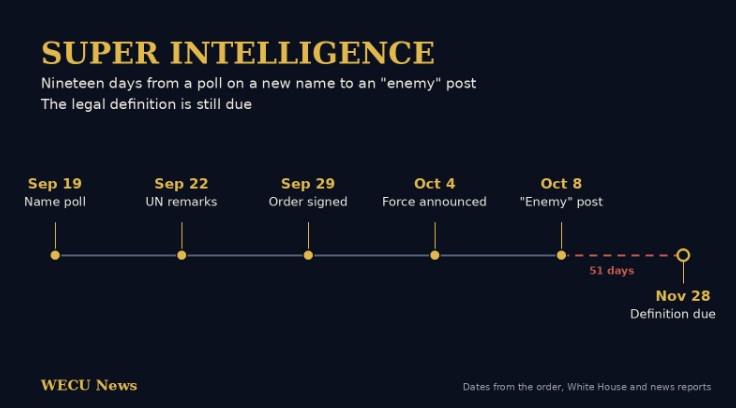
On September 29, President Trump signed Executive Order 14434, "Inaugurating the Era of Super Intelligence." It directs the executive branch, to the maximum extent permitted by law, to replace "artificial intelligence" and "AI" with "Super Intelligence" and "SI" in official communications, policy documents, websites, and other non-statutory materials. It does not require changes to earlier regulations, contracts or grants.
Section 3(a) states what the new terms cover for now: the same technologies and systems defined as artificial intelligence under 15 U.S.C. 9401(3). The order therefore applies the label "Super Intelligence" to the systems that federal law already defines as AI. Section 3(b) gives the president's science adviser 60 days, until November 28, to propose legislative language for a federal definition of the terms and to assess whether that definition should modify or replace the existing statutory one.
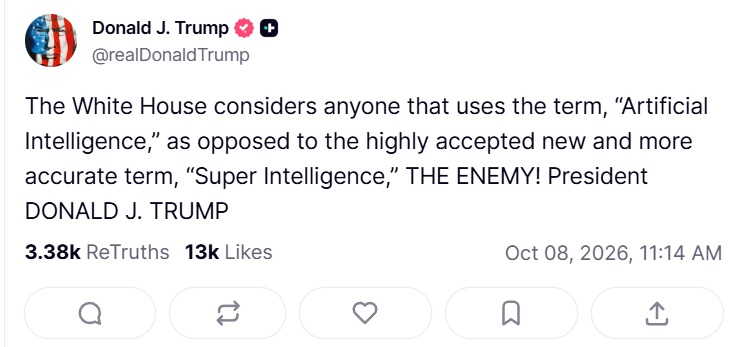
Trump previewed the change at the United Nations on September 22, arguing that the word "artificial" makes intelligence sound fake and that the technology is "actually amazing". On October 4 he announced a Super Intelligence Force to coordinate federal efforts, describing the technology as "bigger than the Industrial Revolution, and the Internet." In a post on October 8, he wrote that the White House considers anyone who uses "Artificial Intelligence" instead of "the highly accepted new and more accurate term, 'Super Intelligence,'" to be "THE ENEMY!"
Super Intelligence- A Name the Field Already Uses for a Different Threshold
In AI research, "superintelligence" has carried a specific meaning for more than a decade. Philosopher Nick Bostrom, who popularized the term in his 2014 book "Superintelligence: Paths, Dangers, Strategies", defined it as "any intellect that greatly exceeds the cognitive performance of humans in virtually all domains of interest." Leading AI companies already use the term for their future goals. Meta named its AI division Meta Superintelligence Labs, and Ilya Sutskever's company is Safe Superintelligence Inc.
The same word anchors the safety debate. A Statement on Superintelligence calls for a prohibition on developing such systems until there is broad scientific consensus that it can be done safely and controllably and strong public buy-in. It has drawn more than 77,000 signatures, and Geoffrey Hinton and Steve Wozniak have signed a petition for a moratorium. In September, Anthropic researcher Evan Hubinger posted that he personally thinks the chance of AI killing all humans within a decade is above 10 percent, and that "we do not yet have a plan to solve alignment for superintelligence and are not clearly on track to." He added that he believes Anthropic is trying its best. That is one researcher's view, offered on social media, and it uses the term in its established sense: a capability that does not yet exist.
What the rebrand claims
The White House fact sheet for the order frames the rename as recognition of the "continuously advancing technological frontier." It says the name "conveys the true capabilities of the technologies being developed today" and describes them as "unlocking new forms of human creativity and empowering Americans to achieve what was previously impossible," in contrast to "simply imitating or automating human intelligence as is implied by the term 'Artificial Intelligence.'" It also states that "the United States is the world leader in Super Intelligence," and that agencies are to "no longer acknowledge" the terms "Artificial Intelligence" or "AI."
Read together, those statements describe current technology in the language of a capability that the field describes as not yet built. They sit beside the order's own text, which equates the new terms with today's statutory AI. Until Congress or a later presidential action changes the law, federal agencies will say "SI" while statutes, many state laws, contracts and internal policies continue to say "AI." Organizations that work with both will manage two vocabularies that refer to the same systems in some settings and not necessarily in others. If the November 28 proposal keeps the equivalence, "super intelligence" remains a label for current AI in federal use. If it draws a line between present systems and a higher capability, statutes and contracts will read the term differently from agency communications.
Public understanding is already splitting
Comments on a September 30 WECU News Facebook post that asked which term readers preferred illustrate the drift. One reader asked what the difference is between the two terms, a question the order does not answer. Another described superintelligence as an existing, error-free pattern-recognition tool and pointed to a case involving a former Google engineer who uploaded files to a personal account. Reporting on that case, covered in Long Dwell, describes a human insider theft, and Google learned of it when it found he had presented his own startup to investors in China.
Replies under Trump's Truth Social posts included supporters who objected to the change or asked why the platform itself still says AI, and one who treated AI as an evil entity under any name. Comments are not a survey. They show that some readers already treat the terms as interchangeable or as describing present-day tools, while others reject the framing.
National polling has measured concern about AI, and none of the surveys found ask what people think "super intelligence" means. Pew's June survey of 3,488 adults found that 52 percent were more concerned than excited about AI in daily life. Republicans stood at 49 percent, down from 59 percent in 2023, and Democrats at 56 percent, up from 46 percent. The survey was fielded before the rename.
Why the distinction is not cosmetic
Calling current systems "Super Intelligence" leaves their capabilities where they were and alters the language available for discussing the gap between those capabilities and a system that, by the research definition, would outperform the best human minds across virtually all domains. The original term exists to mark that gap, and the safety petition and the Hubinger post above use it that way. When official policy applies the same word to systems already in use, discussion of a higher capability, and of the conditions under which it could be developed safely, may become harder to separate from ordinary product updates.
The November 28 proposal is the first formal opportunity for the government's own definition to become public. Any change to the underlying statute would still require legislation. In the meantime, the order has put the name in official use for today's technology, while the field keeps the term for a capability it says no one has built.