Flash flood on Nepal-Tibet border kills at least 270; hundreds still missing
A glacier collapse on the Nepal-Tibet border unleashed a flash flood that has killed at least 270 people and left hundreds of tourists and pilgrims from over 30 countries missing.
By Lynn Matthews - August 27, 2026
RASUWA / KATHMANDU — A wall of ice, mud and rock tore down a Himalayan gorge on the Nepal-China border Wednesday morning, killing at least 270 people in Nepal and leaving hundreds missing on both sides of the frontier, including large numbers of foreign tourists and pilgrims.
BREAKING: At least 380 people missing after flash flood hits near Nepal-Tibet border pic.twitter.com/iCRpXJaBAe
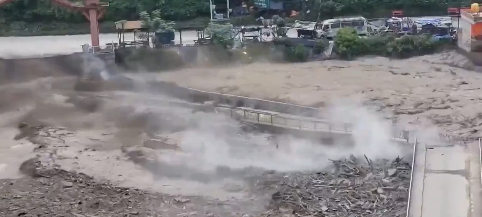
The surge struck without useful warning. It flattened riverside settlements in Rasuwa, wrecked the Rasuwagadhi-Gyirong border crossing, snapped bridges, and carried bodies and debris far downstream into the Trishuli and Narayani plains.
What happened
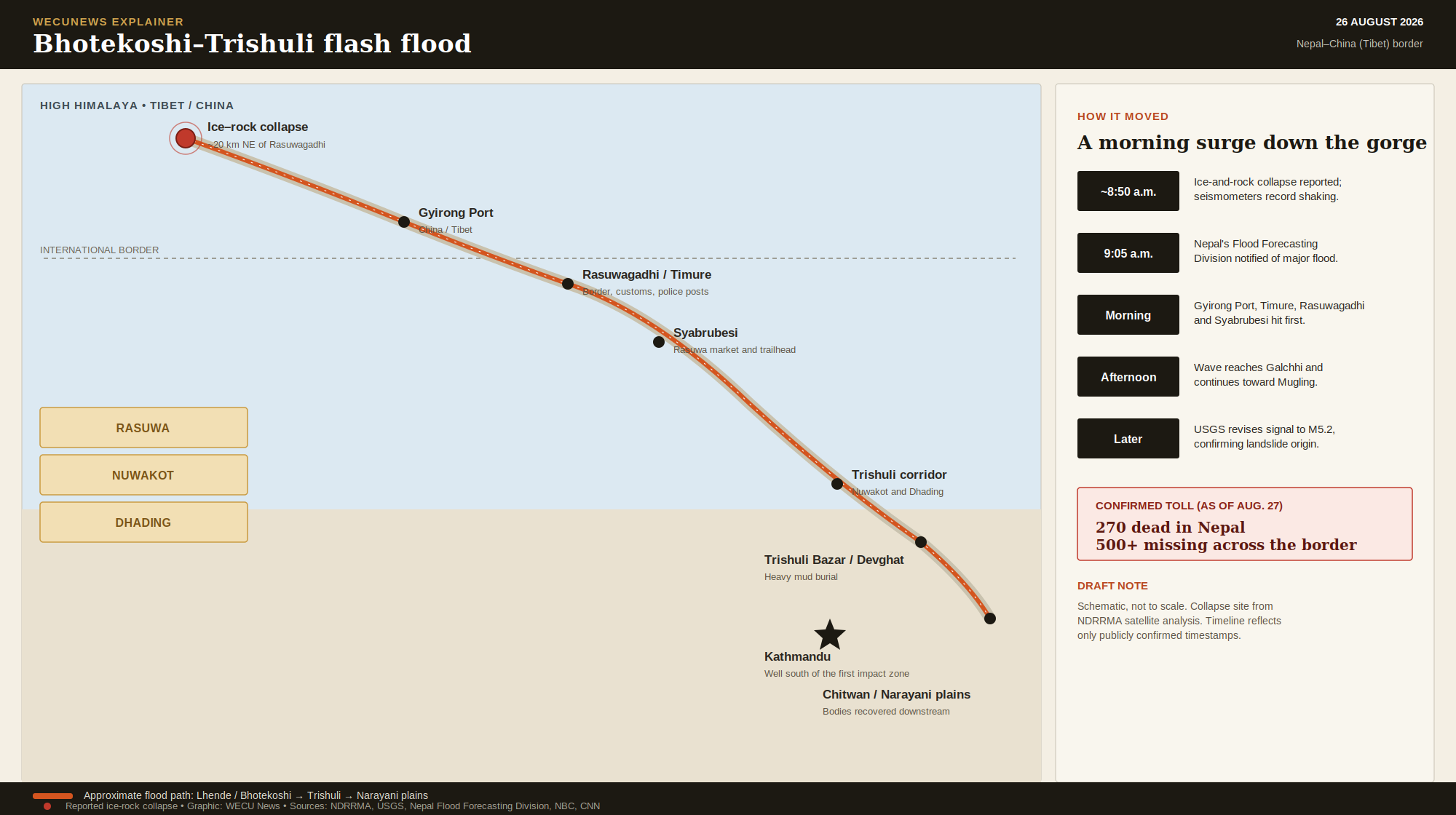
Shortly before 9 a.m. on Aug. 26, a large ice-and-rock collapse occurred about 20 kilometers northeast of the Rasuwagadhi border point, according to Nepal’s National Disaster Risk Reduction and Management Authority, which cited Planet Labs satellite imagery.
Seismometers first recorded a jolt initially listed as a magnitude-4.4 earthquake in Tibet. U.S. officials have since confirmed the shaking was not a tectonic quake but was generated by the landslide itself — a glacial collapse and debris flow whose seismic signal was revised to about magnitude 5.2. The debris dumped into the Lhende River on the Tibetan side, known in Nepal as the Bhote Koshi. Within minutes, the gorge was full. Water levels on the Trishuli River rose by as much as 9 meters, or 27 feet, in just 30 minutes. On the Chinese side, the flood hit Gyirong county and the Gyirong port of entry.
Nepal’s Flood Forecasting Division was notified at 9:05 a.m. that a major flood had entered from Tibet. Officials say it was not caused by heavy rain in Rasuwa.
Path of the flood
The first Nepali impact was the border strip: Timure, Rasuwagadhi and Syabrubesi. Customs yards, police posts, parked trucks and the friendship-bridge area were overrun. Armed Police personnel at Timure were among those swept away. The same crossing lost its bridge in a July 2025 flood and had only recently been restored.
The water then ran down the Bhote Koshi into the Trishuli and through Nuwakot, Dhading, Gorkha, Chitwan, Tanahun and Nawalparasi East. By afternoon it had reached Galchhi and was heading toward Mugling. Many of the recovered bodies were found far downstream, not only at the border.
Authorities say at least 19 bridges and tens of kilometers of road were destroyed, along with hydropower plants and stretches of the main overland trade route to Tibet.
Prime Minister Balendra Shah has made search, rescue and care of the injured the government’s first priority. The army, Armed Police Force and Nepal Police are in the field, with helicopters deployed where conditions allow. India has sent relief supplies, the United States announced emergency aid, and the United Nations said it is mobilizing support. Chinese Premier Li Qiang visited the affected area in Gyirong.
Authorities have issued a further warning: a barrier lake formed after the collapse could breach in the coming days, posing a renewed flood risk downstream.
What remains unknown
While U.S. officials have attributed the flooding to a glacier collapse, the precise combination of factors — including whether rainfall or a debris dam played a role — is still being assessed. Claims that construction on the Chinese side worsened the disaster have not been independently confirmed. The final death toll remains unknown, and identifying the dead is expected to take time.