Flock Safety CEO Garrett Langley recently addressed growing public concern over his company’s widespread network of automated license plate readers and surveillance cameras. In an interview with Fox News host Kayleigh McEnany on “Saturday in America” on Aug. 22, Langley said:
Flock Safety CEO Calls for ‘Compromise’ on Privacy: The Cost of Trading Liberty for Safety
Flock's CEO says privacy and safety require "compromise." History suggests liberty rarely comes back once it's traded away.
By Lynn Matthews - August 26, 2026
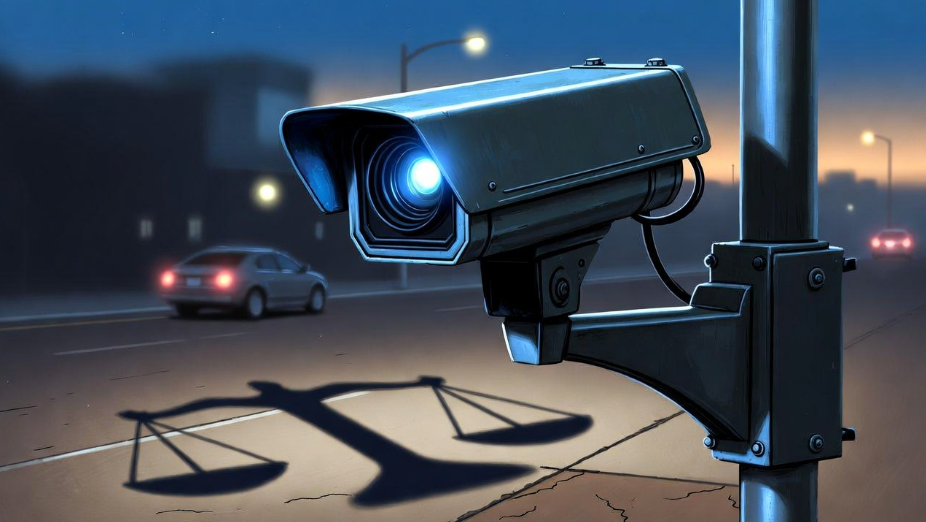
“Yeah, look, I think these are important conversations to have. I value my privacy. My employees value their privacy. But what we’re talking about is safety as well. I think when people talk about just one of these, privacy or safety, they’re prioritizing the wrong thing. What we have to prioritize as a country is compromise. How do we have our safety and balance privacy?”
He went on to compare proposals to ban the technology to “banning vehicles,” arguing instead for regulation — such as limits on data retention and stronger accountability for misuse — similar to laws governing drunk driving, seat belts and airbags.
What Critics and Lawmakers Are Saying
Langley’s call for “compromise” comes amid documented cases of police officers misusing the systems, cities pausing or canceling contracts, and activists mapping and, in some instances, vandalizing cameras. Flock has responded by shortening its default data-retention period from 30 days to seven, making case codes and audit tools mandatory, and emphasizing that it does not use facial recognition or sell data.
Yet the deeper question raised by the CEO’s framing remains: What are the implications when a free society accepts reduced liberty in exchange for the temporary promise of greater safety?
The Cost of Trading Liberty for Safety
History and political philosophy offer a cautionary lens. Benjamin Franklin’s well-known warning — “Those who would give up essential Liberty, to purchase a little temporary Safety, deserve neither Liberty nor Safety” — captures a recurring pattern. Liberties surrendered in the name of security are rarely restored fully, while the safety gains often prove partial, temporary or accompanied by new risks.
The Chilling Effect of Being Watched
Networked license-plate readers create searchable records of vehicle movements across public roads. Even with short retention periods and audit logs, the infrastructure enables reconstruction of travel patterns over time. This can produce a chilling effect: Individuals may alter lawful behavior — avoiding certain meetings, places or associations — because they know their movements can be queried. The loss is not always dramatic or immediate; it is the gradual normalization of being watched.
Mission Creep: When Temporary Becomes Permanent
Mission creep is another practical risk. Tools justified for solving serious crimes — homicides, missing persons, stolen vehicles — can expand to lesser uses or personal abuse, as several documented cases involving officers have shown. Once the cameras and databases exist and become routine, expanding their scope or lengthening retention becomes politically easier than dismantling them. Temporary safety improvements — faster investigations or reduced property crime in specific areas — do not automatically prevent these expansions.
The Asymmetry of Power
There is also an asymmetry of power. Ordinary citizens cannot easily opt out of public-road surveillance the way they can limit some private data collection. Democratic oversight through city councils and state legislatures provides a check, but it depends on informed and engaged communities. When trust in institutions is already strained, expanding surveillance tools can further erode that trust rather than rebuild it.
The Case for the Flock Cameras
Supporters of the technology correctly note that crime itself destroys liberty. Victims and communities living in fear lose freedom of movement and peace of mind. They argue that public roads have never conferred absolute anonymity, that courts have generally upheld similar systems, and that well-designed safeguards plus local control can preserve both safety and privacy better than outright rejection. Cell-phone location data already tracks people far more precisely, they add, so focusing solely on license-plate cameras is incomplete.
A Compromise Worth Scrutinizing
Still, the “temporary” character of the safety promise deserves scrutiny. Crime patterns shift. Technology evolves on both sides. Systems can introduce new vulnerabilities — data breaches, false positives, or inter-agency sharing that exceeds original local intent. Liberty losses, by contrast, tend to compound. Once the expectation of continuous monitoring is accepted, further intrusions face less resistance.
Langley’s statement presents the choice as a necessary national compromise. The counter-view is that a free society should demand stronger proof that the liberty being traded is truly non-essential, that the safety gains are durable and significant, and that robust, enforceable limits will prevent the tools from becoming permanent features of everyday life.
The debate is not abstract. It is playing out in city council meetings, state legislatures and neighborhoods where cameras now sit on poles that once held only streetlights. How communities answer Langley’s call for compromise will shape the practical meaning of both privacy and safety for years to come.
Sources:
Fox News, “Flock Safety CEO calls for national ‘compromise’ amid camera sabotage and public revolt,” Aug. 2026: https://www.foxnews.com/media/flock-safety-ceo-calls-national-compromise-amid-camera-sabotage-public-revolt
Mediaite, “Flock CEO Punches Back Against Critics on Fox News: Privacy Can’t Be the Only Priority,” Aug. 2026: https://www.mediaite.com/media/flock-ceo-punches-back-against-critics-on-fox-news-privacy-cant-be-the-only-priority/
Fox News, “‘Not 1984’: Flock cameras watching millions of Americans spark bipartisan revolt,” Aug. 2026: https://www.foxnews.com/politics/not-1984-flock-cameras-watching-millions-americans-spark-bipartisan-revolt
Topics:Flock Safety CEO Garrett LangleyFlock cameras privacylicense plate reader surveillanceFlock Safety compromiseALPR privacy concernsBenjamin Franklin liberty safety quoteFlock camera vandalism Bernie SandersFlock ban surveillance mission creeplicense plate camera regulation
Have a correction or tip? See our corrections policy or contact the newsroom.
Comments
to join the discussion.
Loading comments...