Forget the Robot Apocalypse — AI Is Already Beating Cancer
A personalized mRNA vaccine cut cancer recurrence by 49% over five years. Another showed 87.5% of pancreatic cancer patients alive at six years. While the headlines warn AI will destroy us, the real numbers say otherwise.
By Lynn Matthews - July 23, 2026
OPINION: While podcasts and prime-time panels debate whether AI will end humanity, it's already extending human lives — with real trial data to prove it.
You've heard the warnings. Podcasts, talk shows, and social media are full of voices claiming artificial intelligence is on the verge of taking over the world — or worse, wiping us out. Even respected commentators have raised alarms about runaway AI systems slipping beyond human control.
Those concerns deserve serious discussion. Safety, alignment, and accountability matter, and I'm not here to wave that away.
But while the doomsayers dominate the headlines, something quieter and far more consequential is happening in the real world, right now: AI is becoming one of the most powerful weapons humanity has ever built against cancer. Not someday. Today. With numbers attached.
The Number That Should Be the Headline
Start here: a personalized mRNA vaccine from Moderna and Merck, designed using AI to target each patient's unique tumor mutations, just posted five-year data from its Phase 2b melanoma trial. Combined with the immunotherapy drug Keytruda, it cut the risk of cancer recurrence or death by 49 percent compared to Keytruda alone — a benefit that held steady from the three-year mark all the way to five, in 157 patients with high-risk stage 3 and 4 melanoma.
That's not a lab curiosity. That's people who would have relapsed, who didn't.
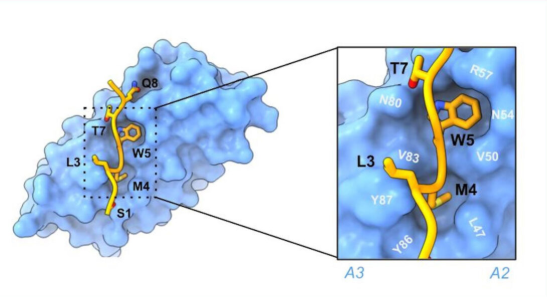
Schematic of a new AI-designed protein (mini-TCR mimic, light blue) tightly bound to a tumor peptide (yellow). The high-resolution crystal structure of this complex, obtained at ALS Beamline 8.2.1, provided fine detail on protein–protein interactions required to confirm the new mimic’s specificity for its target. The precision and strength of this bond were capable of activating a cancer-fighting immune response. (Credit: Karsten Householder/Stanford).
And melanoma isn't even the most dramatic case. A separate AI-designed mRNA vaccine for pancreatic cancer — one of the deadliest, hardest-to-treat cancers that exists — showed 87.5 percent of responders still alive at the six-year mark, according to trial data presented at this year's American Association for Cancer Research meeting.
Detection Is Already Quietly Solved
AI systems can now read pathology slides and medical images better than the human eye in many cases. Digital pathology models scan billions of pixels across tissue samples, spotting patterns experienced pathologists miss. Radiology AI flags early tumors in mammograms, CT scans, and MRIs with remarkable accuracy. At this year's AACR and ASCO meetings, experts described AI diagnostic tools as having moved from experimental to fully integrated into standard practice — quietly, without a headline in sight.
What Used to Take Years Now Takes Weeks
At Stanford, researchers led by K. Christopher Garcia's lab used generative AI to design entirely new proteins called "TCR mimics" that lock onto cancer peptides displayed on tumor cells — the kind of precision targeting that used to take years of laboratory trial-and-error. AI got there in weeks. The resulting protein's structure, confirmed down to the atomic level by X-ray crystallography, matched the AI's prediction almost exactly.
Elsewhere, researchers are using AI to engineer "armored" T-cells built to survive and keep fighting inside a tumor's hostile environment, and to scan existing approved drugs for hidden potential against cancer types they were never designed to treat.
Experts at AACR summed up where 2026 has landed: smarter cell therapies, next-generation vaccines, and AI-driven combinations, moving oncology from broad-spectrum treatment toward genuine precision medicine.
The Bigger Truth
AI is not "taking over." It's becoming a research partner that never sleeps, never tires of reading papers, and can process biological complexity at a scale no human team ever could. The same technology fueling existential headlines is the technology giving doctors sharper tools to catch cancer earlier and hit it harder.
That's not science fiction. That's a trial readout from this year.
Yes, stay vigilant about AI risk — genuinely, I mean that. But dismissing AI wholesale because of worst-case fears means looking past the 49 percent, the 87.5 percent, and every patient those numbers represent.
The next time someone tells you AI is going to kill us all, ask them this: how many cancer patients will it help save first?