How Invisible Software Vendors Are Quietly Handing Over the Grid
By Lynn Matthews - September 19, 2026
At 2:14 AM on a Tuesday, the alarm bells don't ring. There is no cinematic barrage of red warning screens, no frantic ransom demand flashing across a monitor. Just a command, executing exactly the way it's supposed to.
Inside a regional municipal water authority, a routine diagnostic script runs with flawless digital etiquette. The command has valid security certificates. It enters through a whitelisted, encrypted tunnel. To the automated security monitoring system, it looks no different than the thousands of scheduled pings that cycle through the plant's programmable logic controllers (PLCs) every single night.
Except the command didn't originate from the plant's operations floor. It didn't even originate from the tier-one industrial engineering firm the city contracted to monitor its automated chemical scrubbers and high-pressure pumps. It came from an unmonitored server belonging to a four-person boutique telemetry firm in a strip mall three states away, a company whose name appears on no public contract and whose staff has never met the utility director. Nobody has audited its security. Not once.
No specific water authority has reported this exact breach happening on this exact night. What follows isn't a story about one utility. It's a description of a documented, provably exploitable mechanism, built from how these systems are actually wired together right now, in your city and every other one running on outsourced infrastructure.
Welcome to the “Nth-party” vulnerability: the fault line where multi-million-dollar cybersecurity budgets meet the chaotic, outsourced reality of the American supply chain. And it should worry you more than the hackers you've already heard about.
The Blind Spot Behind the Ramparts
For the better part of two decades, the public has been conditioned to imagine critical infrastructure attacks as feats of high-tech digital siegecraft: hostile nation-state operators or shadowy syndicates battering against the outer ramparts of power grids, municipal utilities, and regional shipping hubs. Millions are poured into state-of-the-art perimeter defense, complex password rotations, and zero-day threat intelligence.
Meanwhile, adversaries have stopped looking at the front door entirely.
Why spend months probing a hardened utility network when you can simply walk through the back gate left open by a vendor's subcontractor's software plugin?
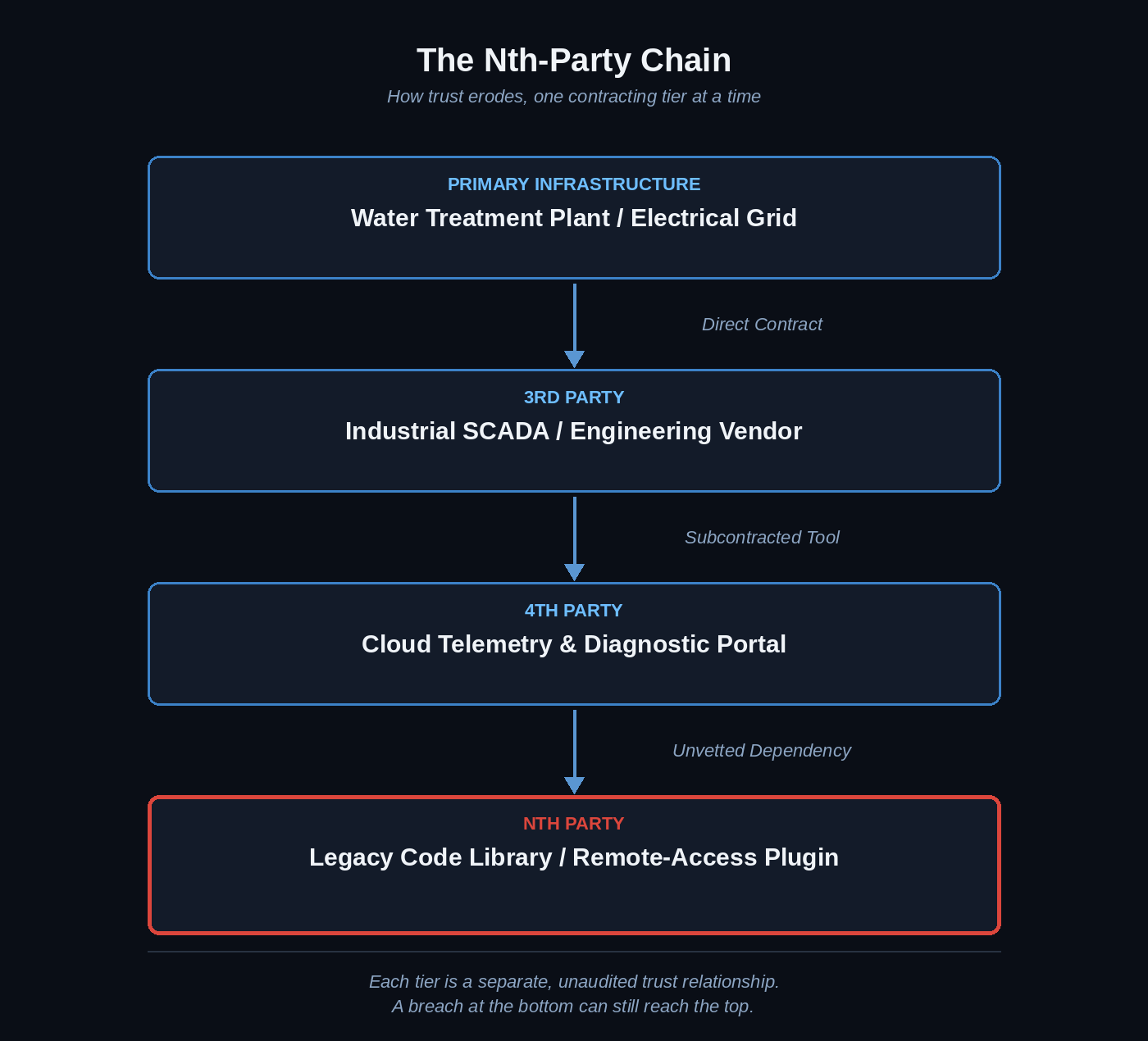
Modern critical infrastructure no longer runs on closed, air-gapped circuits. To cut municipal overhead and modernize aging physical equipment, water plants, electrical substations, and cold-storage logistics hubs have steadily tethered their physical operational technology (OT) to third-party cloud management tools. Those third-party vendors, in turn, rely on fourth-party diagnostic portals. Those fourth-party portals depend on unmaintained, fifth-party open-source code libraries or overseas micro-services to parse telemetry data.
In cybersecurity parlance, this recursive web is known as the Nth-party chain. To an attacker, it is a digital superhighway with no speed limits and no checkpoints. Accountability simply doesn't exist on it, and almost nobody outside the security industry knows it's there.
This Is Not Theoretical. It's Already Happening at the Front Door.
In July 2026, CISA and the FBI confirmed in advisory AA26-097A that Iranian-affiliated actors had breached programmable logic controllers at more than thirty water utilities across Minnesota and at least a dozen other states, changing device passwords and locking operators out of their own systems. The advisory has since been expanded to cover Siemens and Schneider Electric equipment as well. Those attacks used the crudest method available: PLCs left exposed to the open internet, some still running default or weak passwords, the digital equivalent of a bank vault with the combination taped to the door.
Sit with that for a second. If attackers can knock over thirty water systems in one coordinated sweep using the simplest possible method, front-door access to under-protected equipment, imagine what becomes possible once they stop knocking on the front door and start walking in through a vendor nobody is even watching. The Nth-party chain isn't a future risk layered on top of a solved problem. It's the next, wider door in a house where the front one is already getting kicked in.
The Anatomy of the Lateral Hop: From a Buggy Plugin to a Physical Valve
To understand how an Nth-party compromise causes real-world damage, one must examine the operational divide between Information Technology (IT) and Operational Technology (OT).
For generations, the heavy machinery governing civilization operated in total isolation. A water treatment facility's pumps, chemical dosing valves, and pressure tanks were controlled by local controllers hardwired into closed physical loops. Sabotaging a pump or altering water chemistry meant physically picking a padlock on a perimeter fence and manually turning a dial.
Then came remote monitoring. In an era of tight municipal budgets, few operators can afford dedicated, round-the-clock technicians stationed in remote pump rooms. Enter the remote diagnostic portal: automated alerts sent directly to smartphones, real-time analytics hosted in the cloud, and third-party vendors granted constant, “always-on” remote maintenance tunnels.
The core problem is that the industrial hardware running these facilities, specifically legacy programmable logic controllers (PLCs), was engineered in an era before modern network security existed. Industrial controllers rarely feature native multi-factor authentication or internal access segmentation. They are built on absolute trust: if a command arrives over an authenticated protocol, the machine assumes legitimate authority and executes it immediately. No second check. No human in the loop. Just execution.
The trap springs in five steps:
The Target Selection: An attacker bypasses the heavily fortified utility entirely, targeting a minor vulnerability in an obscure software vendor three contracting tiers removed.
The Infiltration: The boutique vendor's platform is compromised. The attacker plants malicious logic inside an upcoming maintenance script or firmware telemetry packet.
The Crossing: The vendor's software initiates its scheduled connection to the utility network over a pre-authorized, whitelisted Virtual Private Network (VPN). The utility's enterprise firewall waves the connection through without friction. It originates from an approved, “trusted” partner.
The Lateral Jump: Once inside the business network, the malicious payload bridges across the internal firewall to the operational technology network.
The Physical Impact: Because the controller expects commands from that diagnostic pipeline, the instruction executes without scrutiny. A pressure threshold is bypassed, a pump is commanded to run dry until its bearings melt, or chemical feeder ratios are altered.
The adversary never cracked a password or breached the perimeter wall. They hitched a ride on a delivery truck that already held a master gate key.
The “Compliance Fiction”: Why Audits Fail to Catch It
Ask any public utility director or enterprise executive how they secure their vendors, and they will point to a binder full of Third-Party Risk Management (TPRM) questionnaires and SOC 2 Type II audit certifications.
These documents are the bedrock of modern institutional risk governance. In practice, they often amount to little more than bureaucratic paperwork theater, and the gaps in that theater are where the damage happens:
The Single-Hop Blind Spot: Vendor assessments universally stop at the entity signing the contract. A utility audits its primary contractor. The primary contractor signs a compliance questionnaire affirming they maintain data security. But the primary contractor rarely audits its own software subcontractors, and the subcontractors almost never review the code dependencies they pulled from the web. Security oversight terminates at the primary invoice line.
The Static Snapshot: An annual audit captures a single point in time. A vendor passes inspection in January. In March, an engineer updates an unverified open-source code package or pushes code through an unencrypted cloud server. The audit certificate on file remains clean, but the pipeline underneath it is already compromised.
The “Zombie” Access Tunnel: External contractors frequently receive dedicated administrative credentials and persistent VPN tunnels for temporary maintenance windows. Long after the project concludes, those remote-access credentials remain active, unmonitored, and unpatched. They sit there as dormant backdoors, waiting.
The Liability Shell Game: Who Pays When the Machinery Breaks?
When an Nth-party failure strikes a physical asset, the resulting fallout exposes a glaring vacuum of institutional accountability.
The dynamic is familiar to anyone who has dealt with utility contractors in the physical world. If an electric utility hires a subcontractor to replace pole hardware, and that subcontractor uses the wrong fittings or leaves a connection loose, the resulting voltage problems can quietly destroy household appliances for months before anyone traces the cause back to the pole. Yet when the homeowner demands restitution, the utility points at the subcontractor, the subcontractor dodges, and the homeowner is left footing the replacement bill. Now scale that same shell game up to a municipal water system, and instead of a dead air conditioner, the cost is measured in contaminated water or a fried substation.
In critical infrastructure cybersecurity, that shell game plays out like this: the public utility demands damages from its primary engineering contractor under breach-of-contract clauses. The primary contractor produces its service-level agreement, proving the flaw originated inside a cloud telemetry portal managed by an outside software vendor. The software vendor cites its standard Terms of Service, noting that its platform incorporates third-party open-source components provided “AS IS, WITHOUT WARRANTY OF ANY KIND.” Cyber-insurance carriers step in, point to fine-print policy exclusions for “unapproved subprocessors” or “unregulated software dependencies,” and deny coverage entirely. The municipal authority, and ultimately the ratepayer, is left to absorb the cost of damaged machinery, environmental remediation, and system downtime.
The Blueprint: Tearing Down the Invisible Highway
Defending critical infrastructure against Nth-party supply chain collapse doesn't hinge on some future breakthrough technology. It hinges on replacing blind institutional trust with verifiable technical controls, starting now, before the next advisory is about something worse than a locked-out password.
1. Mandatory Software Bills of Materials (SBOMs)
Just as the FDA mandates an ingredient label on packaged food, critical operators must require an active Software Bill of Materials (SBOM) for every software system interacting with their networks. Under CISA's newly updated 2026 SBOM Minimum Elements guidance, vendors must disclose all open-source libraries, sub-contracted APIs, and nested components running under the hood. When a critical flaw is discovered in an obscure library, operators shouldn't have to spend weeks investigating whether they are exposed. They should be able to query their software inventory in seconds.
2. Killing the Persistent Tunnel (Zero Trust & Just-In-Time Access)
No external contractor should possess permanent, 24/7 VPN connectivity into operational networks. Systems must transition to ephemeral, Just-In-Time (JIT) access. A vendor requiring telemetry readings or diagnostic access must request a time-bound window, say sixty minutes. Session access must be authenticated via multi-factor controls and monitored with continuous session recording. When the maintenance window expires, the network pathway is automatically severed. If there is no permanent bridge, a breached subcontractor cannot serve as a passive highway for an attacker.
3. Enforcing Subprocessor Disclosure in Procurement
Municipal procurement guidelines must be restructured to enforce downstream liability. If a primary industrial vendor outsources data processing, monitoring, or code maintenance to a downstream party, the utility must receive contractual notification, retain approval authority, and mandate that baseline CISA Cross-Sector Cybersecurity Performance Goals apply to the entire vendor chain.
The Bottom Line
The physical world and the digital world have permanently fused. The valves that treat municipal drinking water and the switchgear that stabilizes the electrical grid are no longer mere assemblies of steel and copper. Neither is the refrigeration keeping the food supply cold. All of it now sits at the far end of an opaque, multi-tiered supply chain of subcontracted code, and almost none of that chain is being watched.
As long as oversight terminates at the primary contract line, perimeter defense is an expensive illusion. Thirty water utilities in Minnesota just found out what happens when someone gets through the front door (see AA26-097A again). Nobody has yet had to find out what happens when someone walks in through the back one, quietly, through a vendor nobody was ever auditing in the first place. That's not a reason to look away. It's the reason to fix it before we find out.