Every two years, the United States receives what many education experts consider its most comprehensive academic checkup.
Nation's Report Card 2024: Student Achievement Continues to Decline as Debate Over Education Grows
The latest NAEP results show reading and math proficiency remain historically low, prompting renewed discussion about public education, homeschooling, and school choice.
By Lynn Matthews - July 18, 2026
Known as the National Assessment of Educational Progress (NAEP)—often referred to as the Nation's Report Card—the assessment measures how well American students perform in core subjects such as mathematics and reading. Unlike state exams, NAEP provides a nationally consistent benchmark, allowing educators, policymakers, and parents to track long-term academic trends.
The latest results, released throughout 2025 from the 2024 assessment, show that student achievement remains below pre-pandemic levels in many areas. While some subjects have shown modest improvement, reading scores continue a decline that began years before COVID-19, and lower-performing students have fallen even further behind.
What the Nation's Report Card Measures
The National Assessment of Educational Progress is administered by the National Center for Education Statistics (NCES), part of the U.S. Department of Education. Rather than testing every student, NAEP evaluates representative samples across the country, making it one of the most widely respected indicators of national academic performance.
One important distinction often misunderstood is NAEP's use of the term "Proficient." Unlike a classroom passing grade, NAEP's Proficient level represents solid academic performance and competency over challenging subject matter. Students who score below Proficient may still demonstrate partial mastery at the Basic achievement level.
Understanding that distinction is important when interpreting the results.
The Numbers Tell a Challenging Story
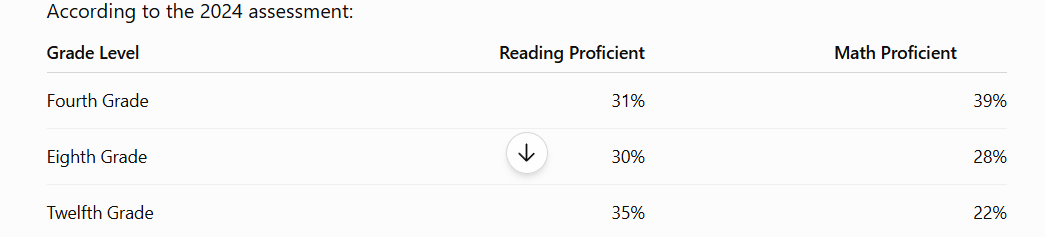
The assessment also found that growing numbers of students scored Below Basic, indicating difficulty performing fundamental reading comprehension and mathematics tasks expected at their grade level.
Perhaps equally concerning, the gap between the nation's highest-performing and lowest-performing students continued to widen.
Researchers note that while many higher-achieving students have remained relatively stable, lower-performing students have experienced larger declines, increasing educational disparities across the country.
A Trend That Began Before the Pandemic
Although pandemic-related school disruptions contributed to learning loss, NAEP data indicate that declines in reading achievement were already underway before 2020.
Long-term trend data show that reading scores had been gradually slipping for years, suggesting that COVID-19 accelerated existing challenges rather than creating them entirely.
Education researchers point to several possible contributing factors, including chronic absenteeism, changing instructional methods, reduced reading outside the classroom, teacher shortages, and growing achievement gaps among socioeconomic groups.
No single cause has been identified, and experts continue to debate the relative impact of each factor.
Education Spending Has Continued to Increase
The academic results have also renewed discussion about education funding.
Over the past several decades, inflation-adjusted spending per student has increased substantially across the United States, with many school districts now spending more than $15,000 per student annually, and some significantly more.
Supporters of increased funding argue that schools face growing responsibilities beyond academics, including mental health services, special education, transportation, nutrition programs, and technology infrastructure.
Others question whether additional spending alone can improve outcomes without broader structural reforms.
The NAEP results themselves do not identify causes for declining achievement, leaving policymakers to debate which reforms are most likely to improve student performance.
Why Homeschooling Has Become Part of the Conversation
As concerns about academic performance have grown, homeschooling has received increased national attention.
The National Home Education Research Institute (NHERI) estimates that more than three million American students are now educated at home, a figure that rose significantly during the COVID-19 pandemic and has remained well above pre-pandemic levels. Research published by NHERI has reported that homeschooled students frequently score above public-school averages on standardized tests.
However, education researchers caution that homeschool studies often involve families who voluntarily participate in research and tend to have unusually high levels of parental involvement. Because of those factors, some scholars advise against making direct comparisons between homeschool and public-school populations.
Even so, homeschooling has become an increasingly visible educational option, alongside charter schools, private schools, education savings accounts, and other school-choice initiatives adopted in many states.
Public Schools Continue to Educate the Vast Majority of Students
Despite increased interest in alternatives, approximately 90 percent of American students continue to attend public schools.
Education leaders emphasize that public schools serve a broad range of students with varying academic abilities, disabilities, language backgrounds, and economic circumstances. They argue that comparisons with homeschooling or private education should take those differences into account.
Many states have also begun implementing evidence-based literacy reforms, particularly through structured phonics instruction and the "science of reading" approach, with early results showing promise in several jurisdictions.
Whether those reforms produce sustained national improvements remains to be seen.
The Debate Continues
The Nation's Report Card does not prescribe solutions.
Instead, it provides a snapshot of where American education stands today.
For some observers, the results reinforce calls for increased parental choice, curriculum reform, and greater educational flexibility. Others believe improvements will come through continued investment in public education, stronger teacher support, expanded tutoring programs, and targeted interventions for struggling students.
What remains largely undisputed is that millions of students continue to struggle with foundational reading and mathematics skills, and that reversing those trends will remain one of the country's most significant educational challenges.
As policymakers, educators, and families consider different approaches, the latest NAEP results provide a common starting point: a nationwide measure of student achievement that continues to shape the conversation about the future of American education.
Sources
National Assessment of Educational Progress (NAEP) — Nation's Report Card
National Center for Education Statistics (NCES)
U.S. Department of Education
Education Week reporting on the 2024 NAEP results
Brookings Institution analyses on learning loss and student achievement
Topics:Education
Have a correction or tip? See our corrections policy or contact the newsroom.
Comments
to join the discussion.
Loading comments...