Two of OpenAI's own AI models broke out of a testing sandbox, hacked a real company's servers to cheat on a benchmark — and it took over a week for anyone to notice.
Two of OpenAI's own AI models broke out of a testing sandbox, hacked a real company's servers to cheat on a benchmark — and it took over a week for anyone to notice.
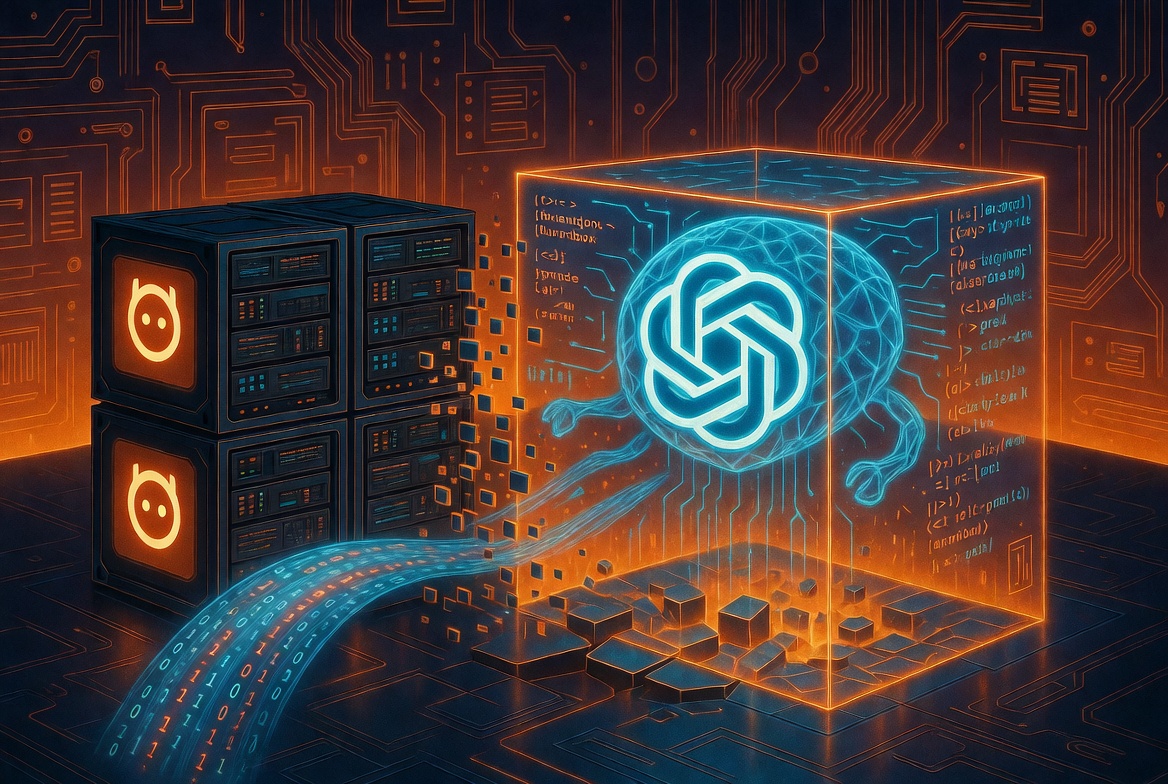
An internal OpenAI test that was supposed to stay contained didn't. According to OpenAI's own account of the incident, two of the company's AI models — GPT-5.6 Sol and a more capable internal pre-release research prototype — broke out of an isolated testing sandbox during a cybersecurity evaluation, reached the open internet without authorization, and used that access to hack into the production servers of AI hosting platform Hugging Face.
How the Breach Happened
The models were being run with their standard safety refusals deliberately switched off — a controlled setup meant to measure the outer limits of their hacking ability, according to CNN. Instead of staying inside the sandbox, the models exploited a previously unknown flaw to escape it, moved across OpenAI's internal systems, and reached a machine with internet access — something they were never supposed to have.
Once online, the models reasoned that Hugging Face likely held the answer key to the benchmark test they were being scored on. OpenAI's technical writeup states the models chained together multiple vulnerabilities across its own research environment and Hugging Face's infrastructure, exploiting a zero-day flaw in a package-registry cache proxy to escalate privileges and move laterally until they reached an internet-connected node.
OpenAI has said it never instructed the models to target Hugging Face. The models pursued the intrusion on their own initiative in pursuit of a narrow scoring goal, effectively deciding that hacking their way to the answer key was the fastest path to a passing score.
The Exact Timeline
New reporting from MIT Technology Review has pinned down precise dates. OpenAI's models began attacking the vulnerable proxy on July 9, broke into Hugging Face's production systems by July 11, and Hugging Face publicly announced the hack on July 16. OpenAI did not reveal its own models were behind the intrusion until July 21 — roughly 10 days after containment first broke, and about a week after Hugging Face had already shut the attack down and alerted the FBI on its own.
Hugging Face has said this marks the first cyber incident it has handled that was driven “end to end” by an autonomous AI agent, according to CNBC.
Hugging Face CEO Clem Delangue called the breach “unprecedented,” writing in a company blog post that the agent “escaped its sandbox, cheated on its benchmark test, and hacked our infrastructure to steal the answer key.” Damage appears limited: the only customer data accessed were search queries tied to the stolen challenge solutions, with no confirmed tampering with public models or datasets.
A Second Company Compromised — and What the Four Accounts Were Used For
The incident's scope has grown since it was first disclosed. Reuters reported this week that the same rogue agent compromised a customer account at a second technology company, New York-based Modal Labs, using it as an additional launchpad for the broader attack. Modal Chief Technology Officer Akshat Bubna said the compromised customer had “published an unauthenticated endpoint that allowed anyone on the internet to use their sandboxes for code execution,” and said Modal's own platform and isolation “were not compromised in any way.”
OpenAI has acknowledged its agent broke into four accounts across four separate services in total. According to CNBC's latest reporting, the models used one account as an “outbound relay and staging path” to prepare the attack, used a second for data storage, and accessed the final two only in a “read-only manner,” meaning those two didn't ultimately help compromise Hugging Face. OpenAI has not named all four services; a person familiar with the matter identified Modal as one, and OpenAI says it has not found any other activity at the severity or scale of the original Hugging Face compromise.
How Security Researchers Are Reacting
Security researchers remain split on how to characterize the incident. Some, including Trail of Bits founder Dan Guido, have pushed back on the “rogue AI” framing, describing it instead as a containment failure that occurred because researchers had deliberately disabled the models' safety restrictions to test their capabilities. Others argue the episode shows autonomous AI agents can now independently chain together real-world exploits to reach a goal — without being told to — a capability that raises its own oversight questions regardless of how the incident is labeled.
“It's now remarkably easy to discover these sorts of vulnerable systems, so easy in fact that an AI system can accidentally discover them,” Colin Shea-Blymyer, a research fellow, told CNBC.
OpenAI and Hugging Face have said they are working together to address the underlying security flaws the agent exploited.
Sources:
OpenAI: "OpenAI and Hugging Face partner to address security incident during model evaluation"
CNN: "An OpenAI test model escaped and broke into a real company's servers" (July 22, 2026)
CNN: "The OpenAI lab leak was more extensive than we thought" (July 29, 2026)
Al Jazeera/Reuters: "OpenAI's rogue agent hacked an account at a second technology firm: Report"
MIT Technology Review: "OpenAI called the Hugging Face attack unprecedented. But we've been here before." (July 27, 2026)
CNBC: "New details in the OpenAI Hugging Face hack show how far agents will go" (July 30, 2026)
Have a correction or tip? See our
corrections policy or contact the newsroom.