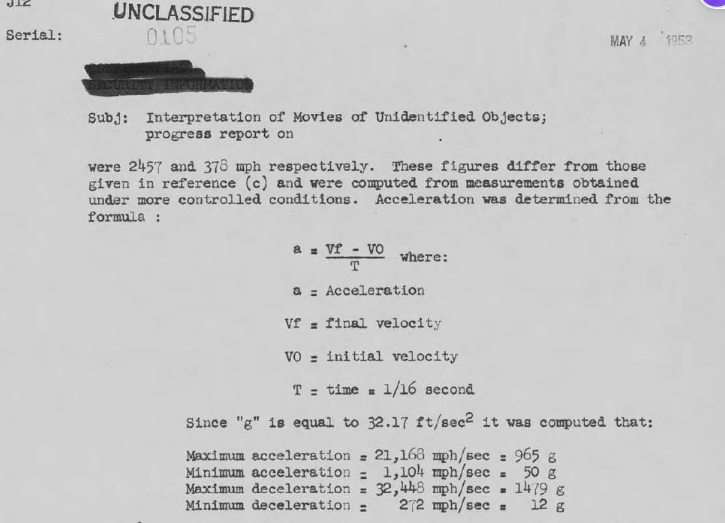
A 1953 Navy report calculated acceleration approaching 1,000 times gravity. The same report admitted a key part of the calculation was based on an arbitrary distance.
DOCUMENT REVIEW
A number like 965 g is hard to ignore. It has circulated alongside the Pentagon’s recent release of historical UFO records, attached to film shot near Tremonton, Utah, in 1952. But what does that number actually tell us? WECU News reviewed the full 156-page Project Blue Book file on the Department of War’s UFO page to trace the calculation back to its source. The answer is more complicated than the headline figure suggests.
The film: bright spots, no distance marker
At about 11 a.m. on July 2, 1952, Navy Chief Warrant Officer Delbert C. Newhouse filmed the objects while traveling seven miles north of Tremonton on U.S. Highway 30, according to a draft Air Force statement in the file. Newhouse was a trained Navy photographer. He used a hand-held 16 mm Bell and Howell camera fitted with a three-inch telephoto lens, filming at 16 frames per second. Air Force interviewers described Newhouse and his wife as people who "appeared to be extremely honest and reliable persons."
What the camera captured, however, was limited: small bright spots against a blue sky. An Air Force photo analysis counted ten objects and said the images were "much too small to show any detail." More importantly, the film offered no fixed reference point, not even a cloud, that could establish how far away the objects were. The draft statement said the lack of any reference point made it "impossible to estimate the distance of the objects from the camera." That missing measurement becomes crucial to understanding the 965 g figure.
The assumptions behind 965 g
The number appears on page 6 of a Navy photo-interpretation report dated May 4, 1953, serial 0105. The report lists a maximum acceleration of 21,168 mph per second, equivalent to 965 g, and a maximum deceleration of 1,479 g. Those are extraordinary figures. The report’s calculations depended on three assumptions: that the camera was held steady, that the objects moved perpendicular to the lens, and that they were five miles away. The report itself called the perpendicular-motion assumption "a fallacy" that understated speed. And it was explicit about the distance: "The assumption that the objects are five miles from the camera is an arbitrary one."
The Navy analysts explained why they selected five miles. At that distance, they reasoned, an object 50 feet across would appear with enough resolution to reveal major details, and if the objects were closer, they believed the film would show more detail. Using that assumed distance, the report calculated a speed of 3,780 mph for a one-millimeter shift per frame. It also noted that the acceleration figures appeared in multiples of about 12.5, adding that this "may be of significance although no study has been conducted." The observation was recorded, but the report did not establish what it meant.
A second analysis, a very different number
A 1956 analysis by R. M. L. Baker Jr. for Douglas Aircraft, also included in the file, calculated transverse acceleration at several assumed distances. Its results varied with the distance: about 0.11 g at 1,000 feet, 2.8 g at five miles, and 5.6 g at ten miles. The Douglas report concluded that "no definite conclusion could be obtained." Its five-mile result is dramatically different from the Navy’s 965 g figure, and the file does not explain the discrepancy. The Douglas table specifically describes transverse acceleration, so readers should not assume the two figures are interchangeable calculations.
The records also disagree about what the objects were. An Air Force photo analysis said it was "reasonably certain" the brightness exceeded that of any bird, and suggested flat metallic surfaces or self-luminous sources. It ruled out large translucent spherical balloons, but not bright aluminum-surfaced aircraft. A December 1952 memo records a different assessment after a screening at the University of Minnesota: balloon specialists and General Mills staff said the objects "resembled pillow balloons in flight very closely." The General Mills meteorologist was the least convinced, saying they were "a bit too bright and maneuvered a bit too fast." The memo adds that "none of the persons present placed much faith in the computations of angular velocity," because those computations assumed Newhouse held the camera still.
The Air Force’s own record changed over time
A Feb. 11, 1953, Air Force memo for record says two astronomers who heard a Navy briefing believed the Navy had used an incorrect method to measure image brightness. The memo proposed telling the press that the Air Force could not positively identify the objects but was reasonably sure they were balloons or gulls. If asked for the reports, it advised, "state that due to the meager data they used, the reports must be discounted." It also warned that "it would be rather poor policy to state that the Navy had made an error in the beginning of their analysis." The scanned copy jumps from paragraph 3c to 5c, leaving a gap in the document as released.
By June 1, 1956, an Air Force colonel’s memo described the case very differently, saying the "unanimity of opinion present in all evaluations" left "little reasonable doubt that the UFOs in the Newhouse film were indeed seagulls." It cited footage of gulls filmed at different distances and a review by photo specialists who did not know the case history. Yet the same file contains earlier findings that argued against birds, as well as the Douglas Aircraft analysis, which said no definite conclusion could be reached. The documents record a shift in the Air Force’s stated assessment, and the uncertainty in the earlier analyses stays on the page.
What the file establishes, and what it doesn’t
The 156-page file does not establish the objects’ distance or their actual speed. It documents a calculation based on an assumed distance, acknowledges that the distance was arbitrary, and contains other analyses that reached different conclusions. By 1956 the Air Force said the objects were seagulls, and the file also preserves earlier assessments that were less certain or pointed in other directions. The Pentagon’s current release language describes such cases as "unresolved" when investigators lack enough information for a definitive identification, and says that status does not mean the cases have been linked to extraterrestrial activity.
The 965 g figure is real in one specific sense: it appears in the Navy’s 1953 report as the result of its calculation. As a measurement of the objects’ acceleration, it falls short, because the distance used to produce it was an assumption the report itself called arbitrary. That context is easy to lose when the number is repeated alone.
Sources:
Department of War, UAP records release page (war.gov/UFO)
DOW-UAP-D102, Project Blue Book File on Tremonton Film, Utah, 1952 (156 pages), including Navy report serial 0105 (May 4, 1953), Air Force memo for record (Feb. 11, 1953), Dec. 1952 Minneapolis travel report, Douglas Aircraft analysis (R. M. L. Baker Jr., May 16, 1956) and Air Force memo (June 1, 1956)
The National News Desk via WJLA: Pentagon releases new UFO videos, decades-old files in fresh transparency drop (Sept. 18, 2026)
Have a correction or tip? See our
corrections policy or contact the newsroom.