A council vote and an independent camera teardown landed the same week, raising the same question: how much do cities really know about what these systems do?
Plymouth, Minnesota's city council voted 6-1 on Tuesday, September 22, to end its contract with Flock Safety and discontinue its camera program. Sixteen permanent units and two portable ones will stop operating before the October and November contract renewal dates. Mayor Jeffry Wosje cast the lone vote to keep the program, though he had also raised concerns of his own about the cameras' vulnerability to hacking. Council members Joel Spoonheim and Julie Pointner were among those who spoke in favor of ending the contract.
Police Chief Erik Fadden defended the program, telling the council that collected data is deleted after 30 days and that department use is restricted to specific purposes. The city attorney told the council directly that Plymouth, not Flock, owns the data collected by its own cameras. That settled the ownership question. It did not settle the trust question. Council members who voted to end the contract weren't disputing who legally owns the data. They were questioning what Flock's own terms of service actually permit, including the use of de-identified data for training its systems, and how much visibility the city has into who else can reach that data once it leaves Plymouth's servers.
Doug Maltby, a resident and retired technologist who has spoken at multiple council meetings on the issue, put it plainly: "There's so many layers to not trusting this technology that I feel we should cancel the contract." He was speaking as a member of the public, not from the dais, but his framing tracked closely with where the council landed.
Minnesota law places some limits on sharing this kind of data with federal immigration enforcement, and that concern came up repeatedly in Plymouth's debate. Flock's own position is that federal data sharing is off by default and configured locally, city by city. That is precisely why several council members said they weren't reassured. A setting that can be switched isn't the same as a restriction that can't be, and Plymouth is one of more than a dozen Minnesota jurisdictions that have pulled back from Flock programs this year over some version of that same distinction.
The council's decision takes effect immediately, though physically removing the cameras from city property will take longer.
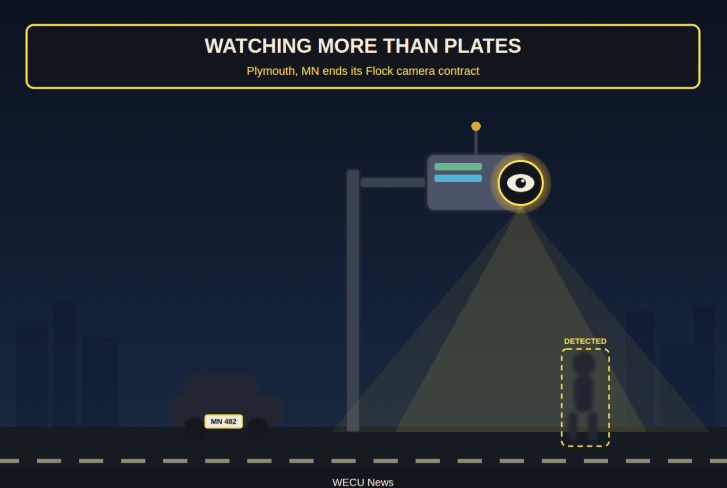
The same week Plymouth voted, 404 Media and WIRED published a joint investigation, drawing on data from the transparency collective DDoSecrets, into what happens inside a Flock camera once you actually open one. A researcher who physically removed a unit and recovered its encryption key found that the on-device software doesn't only process license plates. It also runs detection models for people and bicycles. Flock has long marketed its cameras around license plate reading, and it separately sells people-detection features, including Guardian Mode, on other parts of its product line. What the teardown adds isn't that Flock never mentions people. It's that the roadside plate-reading units themselves, the ones cities like Plymouth install expressly as license plate readers, are already running that detection on-device.
The investigation also found real limits worth stating plainly. There was no evidence of active facial recognition running on the unit examined, beyond unused default components built into the Android system underneath it. Detecting that a person is present in frame is not the same as identifying who that person is. On the specific camera analyzed, people appeared in just 11 clips, all of them motorcyclists caught because the camera was aimed at a roadway. Flock did not respond to questions about the findings.
Two more data points from the surrounding reporting are worth holding onto. In Alpharetta, Georgia, Flock camera data has been shared with more than 2,000 organizations, a list that goes well beyond police departments to include colleges, airports, other government agencies, a fish and wildlife commission, and Medicare fraud investigators, not just police departments. And in Washington, D.C., a police union representative alleged that the department has used its Flock network to track its own officers. MPD disputes the framing, saying the specific license-plate-reader use the union pointed to came out of an internal affairs case involving potential criminal conduct, not routine monitoring of staff. Both things can be true at once, a network built to watch the public turned occasionally inward, and a department insisting each instance was justified. That tension is worth reporting as unresolved, not settled in either direction.
None of this means Plymouth's council was reacting to the teardown. There's no indication anyone on the dais had read it before voting. What connects the two stories aren't connected by cause and effect. It's that a city government spent months asking pointed questions about what a vendor's cameras actually do and who can reach the data, arrived at real doubt even after being told the city legally owns that data, and voted accordingly, in the same week independent researchers demonstrated that these devices already do more, on-device, than their stated purpose suggests. Cities weighing their own Flock contracts don't need to take either story as proof of the worst case. They need to take both as a reason to ask better questions than "does this only read plates."
Sources:
KSTP: Plymouth votes to shut off 18 Flock cameras over privacy concerns
WIRED: Hackers Tore Apart a Flock Camera and Found Way More Than Just License Plates
WIRED: How an Atlanta Suburb Ended Up Sharing Flock Data With More Than 2,000 Organizations
Have a correction or tip? See our
corrections policy or contact the newsroom.