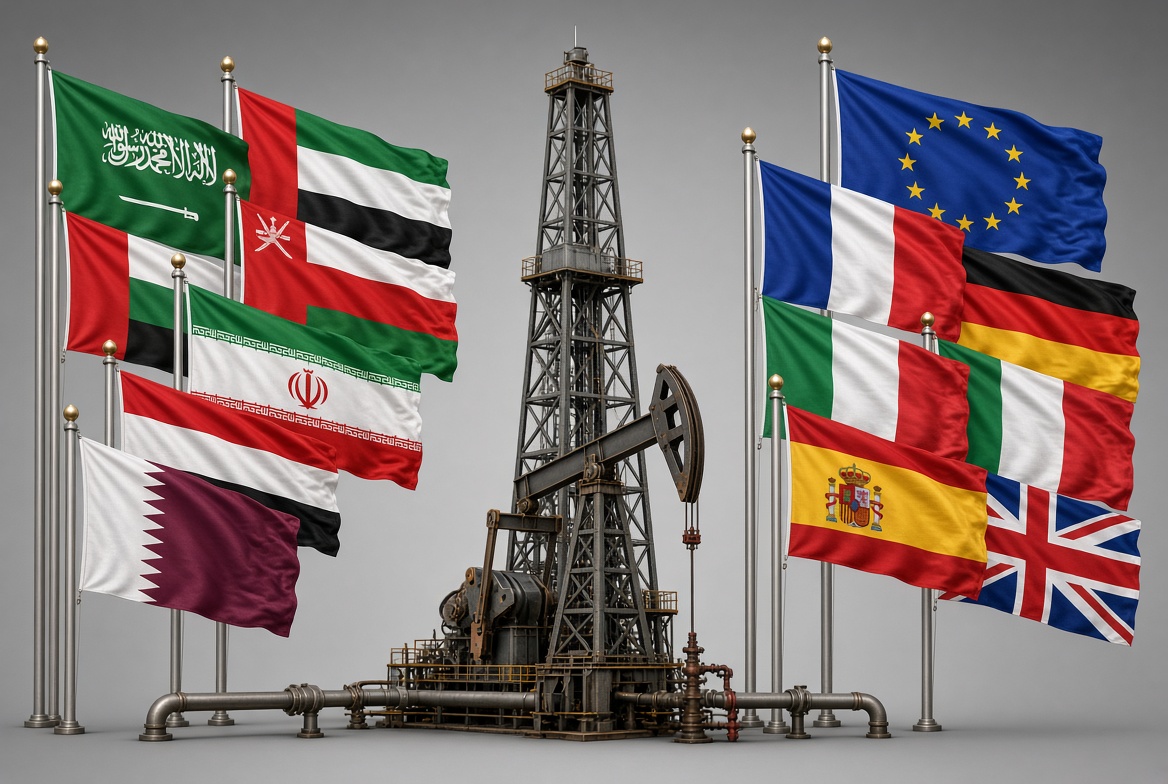
A look at what governments say publicly versus what the underlying data and battlefield activity actually show, in two active geopolitical arenas: the Middle East and European energy policy.
This piece presents a factual record on two separate fronts — the Middle East and European energy policy — comparing official public positions against documented outcomes. No conclusions are drawn beyond what the record itself shows.
The Middle East
Several Gulf states have repeatedly issued official statements condemning Houthi attacks on commercial shipping in the Red Sea and on energy infrastructure. The same states have, in most cases, limited their direct military responses.
Israel has conducted multiple strikes against Houthi-related targets and Iranian-linked assets. Saudi Arabia led a multi-year military intervention in Yemen against the Houthis beginning in 2015 and has carried out further responses to Houthi strikes on its territory and shipping in 2026, including after attacks on Saudi oil facilities and vessels.
The Houthis, who control significant territory in Yemen including the capital Sanaa, have received weapons, training, and technical support from Iran. In 2026 they declared a blockade on Saudi-linked shipping, claimed attacks on Saudi oil tankers, and conducted strikes on Saudi energy infrastructure, including a claimed drone attack on an Aramco facility in Jazan in August 2026. Front-line fighting inside Yemen between Houthi forces and forces of the internationally recognized Yemeni government intensified in the same period.
Oman has maintained diplomatic and technical engagement with Iran, including joint discussions in 2026 on arrangements for navigation in the Strait of Hormuz. Oman has also condemned attacks on vessels in the strait.
Europe and Russian Energy
European Union institutions and member-state governments have issued repeated official condemnations of Russia's invasion of Ukraine and have adopted successive packages of economic sanctions. At the same time, imports of Russian fossil fuels continued under transitional arrangements.
By 2025-2026 the share of Russian gas in EU imports had fallen substantially from its pre-2022 levels, and Russian oil imports were reduced even more sharply. Nevertheless, under long-term contracts still permitted during the phase-out period, Russian liquefied natural gas continued to arrive at ports in Spain, France, Belgium and the Netherlands through at least mid-2026, with limited volumes of Russian pipeline gas also continuing, primarily to Hungary, Slovakia and Greece.
The trend line during this period ran counter to the EU's stated objective. According to a report from the EU's own energy regulatory agency, ACER, Russian gas imports into the EU increased rather than declined during the opening months of 2026, even as the bloc formally began its phase-out: pipeline imports rose 7% year-on-year compared to 2025, and LNG imports grew 11% — accelerating to a 17% year-on-year increase in the months immediately following the ban's initial start date.
The EU's phase-out regulation — formally adopted Jan. 26, 2026 and entering into force Feb. 3 — set a stepwise timeline rather than an immediate cutoff. Short-term LNG contracts were banned starting April 25, 2026, and short-term pipeline contracts starting June 17, 2026. Long-term contracts, which account for the bulk of remaining volume, remain permitted considerably longer: long-term LNG contracts are banned starting Jan. 1, 2027, and long-term pipeline contracts starting roughly September 2027, with Hungary and Slovakia carved out with extended exemptions given their landlocked position.
Official EU statements have consistently described the objective as ending dependence on Russian energy and reducing revenues available to the Russian state. Actual import volumes, and the payments associated with them, continued — and in the case of gas, increased — during the transitional period the regulation itself established.
Sources:
● Euronews, "Russian gas imports rise despite EU phase-out," July 1, 2026
● Council of the EU, Timeline — Ending Russian Energy Imports
● EU Agency for the Cooperation of Energy Regulators (ACER), Russian Gas Phase-Out Monitoring Report, 2026
● Harneys Regulatory Blog, "EU publishes Regulation phasing out Russian gas and oil imports," 2026
● Al Jazeera, "Houthi strikes in Yemen as Saudi Arabia braces for attacks: What we know," Aug. 7, 2026
● Al Jazeera, "Houthi attacks on gov't forces hint that a major battle in Yemen is brewing," Aug. 7, 2026
Have a correction or tip? See our
corrections policy or contact the newsroom.