Ask why data centers are straining the power grid, and the answer usually points to natural gas plants or coal. Increasingly, the answer tech companies are giving is nuclear — specifically, small modular reactors and microreactors, a category of nuclear power plant built at a fraction of the size of a traditional station. The pitch, at least: faster to build, safer by design, and small enough to sit next to the data center it powers instead of requiring a new transmission line across three states.
Small Nuclear Reactors Are Suddenly Everywhere. Are They Actually Ready?
Tech firms say small nuclear will power AI data centers. Five U.S. test reactors went critical this summer. Commercial SMR power is still years away.
By Lynn Matthews - September 2, 2026
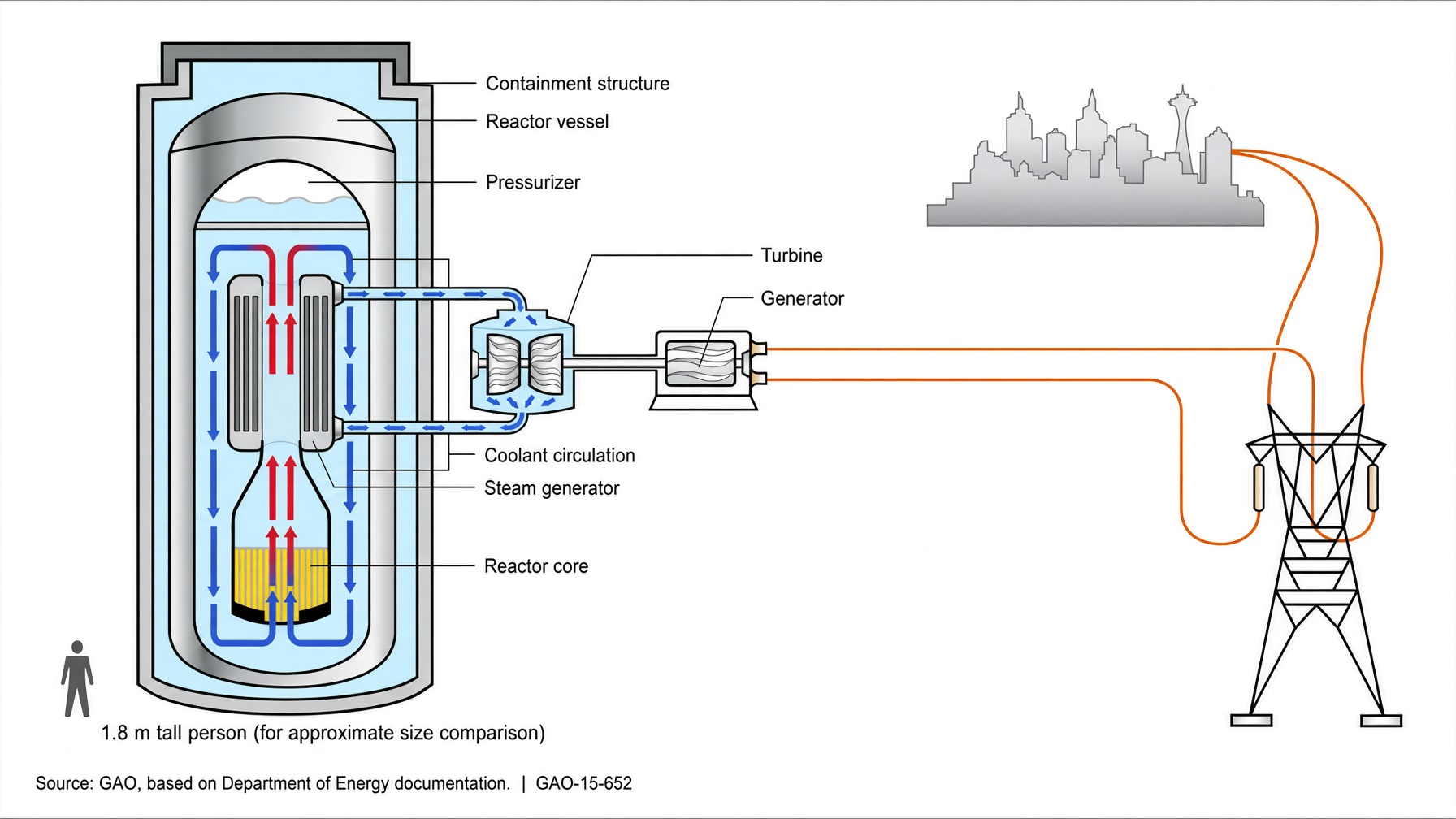
The federal government has bet on the same idea. Executive Order 14301, signed in May 2025, set a goal of three advanced reactors reaching criticality — the point where a nuclear reaction becomes self-sustaining — by July 4, 2026, running through Department of Energy authorization rather than the standard, much slower Nuclear Regulatory Commission licensing process.
What's actually running versus what's still a plan
Eleven projects across ten companies are competing in that DOE pilot program, building reactors ranging from 100 kilowatts to nearly 200 megawatts. The July 4 deadline has already come and gone — and DOE didn't just meet it, it beat it. Four reactors reached criticality before the deadline: Antares Nuclear's Mark-0 microreactor at Idaho National Laboratory on June 4, Valar Atomics' Ward 250 in Utah around June 18, Deployable Energy's Unity reactor at INL around July 1, and Aalo Atomics' Aalo-X reactor at INL on July 4 itself, which DOE described as a "zero-power fueled criticality demonstration." Energy Secretary Chris Wright's framing: the administration was asked for three, and "we have surpassed that ask and delivered four."
Oklo's Groves reactor followed on August 5 — fifth to reach criticality that summer, not first, and the only one built on private land rather than at a national lab. Groves is a pilot unit built to produce medical isotopes rather than grid power, constructed in 229 days, which Oklo calls the fastest U.S. non-military reactor build under modern environmental and DOE regulations. That's a genuine milestone for Oklo specifically — but all five of these criticalities, across all five companies, are demonstration or zero-power/isotope-scale tests, not power plants selling electricity to anyone. None of them has produced a single commercial megawatt-hour. Oklo's own commercial power-generating units aren't expected to begin operating until 2027, with analysts not projecting meaningful revenue until 2028.
On the corporate side, every major hyperscaler has now signed a nuclear deal: Google contracted with Kairos Power for up to 500 megawatts of small-reactor capacity, with its first unit aimed at 2030. Amazon signed with Energy Northwest for small modular reactors, plus a roughly 1.9-gigawatt arrangement with Talen Energy tied to Talen's existing Susquehanna nuclear plant. Meta's nuclear commitments span multiple companies, including a long-term deal with Constellation Energy. Microsoft's deal with Constellation involves restarting a reactor at Three Mile Island, not building a new small reactor at all.
None of the new small-reactor deals is delivering power yet — that part of the pitch is entirely a future promise. It's worth being precise, though: Microsoft's soonest path to nuclear power runs through restarting an existing large reactor, not a new SMR, and Amazon's Talen arrangement draws on an already-operating plant rather than new construction, so "nuclear electrons" and "small modular reactor electrons" aren't quite the same claim. Either way, none of it is small modular reactor power, and none of the SMR-specific projects above have sold a single megawatt to a customer.
The part the industry doesn't lead with
Small modular reactors have failed to deliver on their promise before, and recently. NuScale's flagship U.S. project, a planned six-reactor plant for a coalition of Western utilities, was canceled in November 2023 after its projected price rose from about $58 per megawatt-hour to $89, driven by construction cost estimates climbing from $5.3 billion to $9.3 billion before a single reactor was built. That's the same cost-overrun pattern that has plagued large nuclear projects for decades — Georgia's Vogtle Units 3 and 4 ultimately cost roughly $36 billion, more than double original estimates, and took 15 years.
Cost analysts generally put first-of-a-kind small modular reactors at $80 to $180 per megawatt-hour today — more expensive than natural gas and not clearly cheaper than large nuclear plants. The entire economic case for SMRs rests on a "learning curve" argument: costs are supposed to fall as more units get built and manufacturers gain experience, the same way costs fell for solar panels and wind turbines. That curve is a projection based on how other industries behaved, not something small nuclear reactors have actually demonstrated yet at scale. Whether it holds is the real open question the hype cycle tends to skip over.
What this means for the data center debate
None of this means small nuclear is a scam or that it won't eventually work. Serious companies and the federal government are putting real money and a real regulatory path behind it, and five demonstration criticalities in one summer is not nothing. But for readers hearing "AI data centers will run on clean nuclear power" as a settled fact: it isn't one yet. Every small-reactor deal signed so far is a bet on machines that are not selling power today, priced years out, from a technology with a recent, well-documented history of costing more than promised. Some of the nuclear paper on the table is different — power from plants that already exist, or a large reactor being brought back online. That's not the same thing as a new SMR next to a new data hall. The campuses going up now — the ones straining local grids and water supplies today — are still years ahead of the small-reactor capacity that's supposed to eventually offset them.
Sources
U.S. Department of Energy, "Department of Energy Celebrates Fourth Criticality Ahead of July 4th Goal"
NucNet, "Antares Achieves Initial Criticality of Privately Developed Advanced Nuclear Reactor"
The Motley Fool, "Oklo Built a Nuclear Reactor in 229 Days. Here's Why the CEO Calls It a World Record."
Canary Media, "Future of small reactors at stake as NuScale deal flops"
How to Store Electricity, "SMR Cost 2026: Overnight Capex, LCOE Ranges, the NuScale Cancellation, Darlington's C$20.9bn"
Topics:small modular reactorsSMRsmicroreactorsnuclear power data centersAI data center electricityDOE Reactor Pilot ProgramExecutive Order 14301advanced nuclear reactorsnuclear criticality 2026Oklo GrovesAalo AtomicsAntares NuclearValar AtomicsDeployable EnergyKairos Power GoogleAmazon Talen EnergyThree Mile Island MicrosoftNuScale cancellationSMR costfirst-of-a-kind nuclea
Have a correction or tip? See our corrections policy or contact the newsroom.
Comments
to join the discussion.
Loading comments...