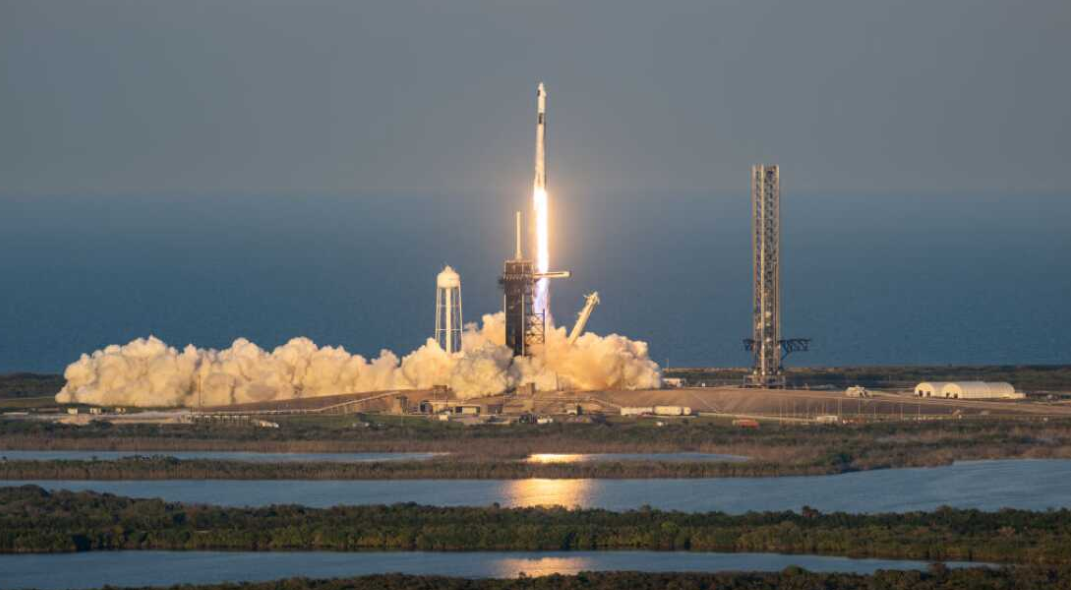
VERMILION PARISH, La. — Louisiana is on the verge of landing what could become one of the largest economic development projects in state history: a SpaceX spaceport on roughly 130,000 acres of coastal marsh near Pecan Island. But the real story isn't just another launch pad. The site's south-facing location on the Gulf of Mexico is uniquely suited to something SpaceX has spent this year turning from rumor into confirmed hardware — a constellation of satellites designed to run artificial intelligence computing in orbit. That constellation now has an official name: Starmind.
The Deal on the Table
Gov. Jeff Landry's administration is reportedly in the final stages of a deal that would transfer control of a massive tract of coastal Vermilion Parish land to SpaceX. The land became available through the state's recent settlement of long-running coastal lawsuits against ExxonMobil. The area around Pecan Island and Freshwater City offers deep-water barge access, nearby natural gas infrastructure, and — most critically — a clear southward launch corridor over the open Gulf, allowing rockets to reach polar and sun-synchronous orbits without flying over New Orleans or other population centers. An official announcement is expected later this month; neither SpaceX nor the Landry administration has publicly confirmed the deal's terms.
Why Polar Orbit Matters
Most of SpaceX's current launches from Texas and Florida head east into lower-inclination orbits. The Starmind satellites need something different. First-generation Starmind hardware, called AI1, is designed to operate in sun-synchronous orbit — a near-polar path that keeps a satellite's solar arrays in continuous sunlight. No night. No weather. No atmospheric losses. According to Starmind's own published specifications, each AI1 satellite stands 20 meters tall with a 70-meter deployed wingspan — wider than a Boeing 747-8's fuselage — and is built around Nvidia's Vera CPUs and Rubin GPUs, delivering roughly 120 kilowatts of sustained compute power and up to 150 kilowatts at peak, cooled by deployable liquid radiators that dump heat directly into the vacuum of space rather than relying on the water and grid power that constrain ground-based data centers.
SpaceX has filed with the FCC for authority to launch up to one million of these satellites, with manufacturing planned at a new facility dubbed Gigasat. First AI1 prototypes are targeted for early 2027, with volume production expected to ramp later that year.
The Louisiana Legislature Already Knows What's Coming
Louisiana lawmakers didn't wait for an official announcement to start preparing the ground. This spring, the legislature passed House Bill 1098, now codified as Act 874, which grants aerospace companies broad legal immunity from lawsuits over sonic booms, vibration, noise, smoke, light, and other disturbances tied to rocket launches. The bill cleared the Senate 33-3 and, according to reporting on the legislative session, explicitly bars residents from suing aerospace companies for property damage or diminished quality of life caused by routine launch activity — though it does not cover intentional acts or violations of FAA licenses.
The bill's eligibility requirement is the detail worth noticing: it applies only to companies that own or occupy at least 20,000 contiguous acres in Louisiana — a threshold well below the roughly 136,000 acres reportedly involved in the Vermilion Parish deal, but high enough to exclude smaller operators. Louisiana Economic Development Secretary Susan Bourgeois has acknowledged the department examined what incentive packages other states offered aerospace companies and built Louisiana's package to compete, while declining to confirm any specific project tied to the legislation. Additional bills passed this session provide sales tax rebates and property tax exemptions for aerospace manufacturers, and exempt qualifying companies from certain public records requirements.
State Sen. Bob Hensgens, who represents Vermilion Parish, has been openly enthusiastic about what the deal could mean for the region, telling reporters he wants to see the area "Cajunized" the way the mid-20th century oil boom once defined the local economy: "When the oilfield came and employed that many people, you couldn't go almost anywhere in the world, go on a drilling platform, and not find a Cajun out there. We became part of the oilfield."