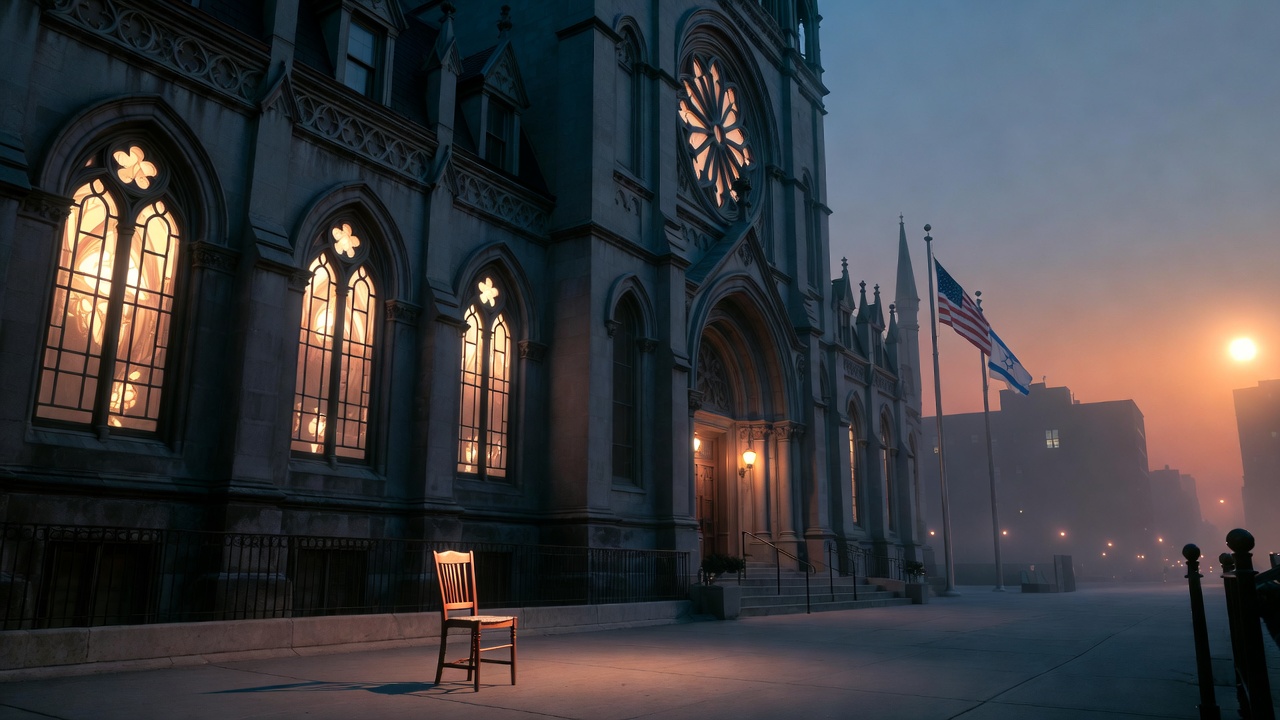
A Synagogue in Manhattan, and a Pattern That Predates This Week
Just after 6 p.m. Friday, as Shabbat services were beginning at Central Synagogue in Manhattan, a man later identified as 46-year-old Larry Montes disrupted the service, struck a 63-year-old congregant, damaged synagogue property, and spat at and headbutted a member of the synagogue’s security team as he was being removed from the building. An NYPD sergeant on duty took him into custody on the spot. He now faces hate crime charges, including assault and criminal mischief, per NYPD Commissioner Jessica Tisch.
מתפרע אלים נכנס לבית כנסת בניו יורק במטרה לפגוע ביהודים - ונעצר.
— Danny Danon 🇮🇱 דני דנון (@dannydanon) August 15, 2026
זו עוד תזכורת מצמררת לכך שהאנטישמיות אינה שייכת לעבר, היא מתרחשת כאן ועכשיו, בלב ניו יורק.
כאשר ראש עיריית ניו יורק מפיץ שנאה, אלו התוצאות.
אפס סובלנות לאנטישמיות. אפס סובלנות לאלימות נגד יהודים. pic.twitter.com/BXpokc1lvz
No one was seriously hurt. Services continued after Montes was removed. His precise motive has not been confirmed, and this piece does not assert one — but the act itself is not in question: a man walked into a house of worship and was violent toward the people inside it. That much is true regardless of what investigators ultimately determine about why.
It is also, unfortunately, not isolated.
The numbers behind one Friday night
Last month, Jews were the target of 70 percent of all hate crimes in New York City, despite making up roughly 10 percent of the city’s population, according to NYPD data reported by the Times of Israel. There have been at least 205 anti-Jewish hate crimes in New York City so far this year.
Nationally, the Anti-Defamation League’s 2025 audit — released in May — recorded 6,274 antisemitic incidents in the United States, a 33 percent decrease from 2024’s 9,354. On its face, that looks like progress. But buried inside the decline is a harder fact: physical assaults reached a record high, 203 incidents, up from 196 in 2024, and assaults involving a deadly weapon rose nearly 40 percent, from 23 to 32. Three people were murdered in antisemitic attacks in 2025 — the first American Jewish deaths from antisemitic violence since 2019 — including a shooting at the Capital Jewish Museum in Washington, D.C., and a firebombing at a Boulder, Colorado vigil for Israeli hostages.
Globally, the J7 Task Force’s 2025 report — covering the seven countries home to more than 90 percent of the world’s Jewish diaspora — called 2025 the deadliest year for antisemitic violence in the diaspora in more than 30 years. Twenty people were murdered in antisemitic attacks across Sydney, Manchester, Washington, and Boulder.
A documented pattern, not a coincidence
There is a formal framework for understanding how hatred escalates into violence, developed by Dr. Gregory Stanton, founder of Genocide Watch, after studying the Holocaust, the Armenian Genocide, the Cambodian Genocide, and Rwanda. Stanton’s “Ten Stages of Genocide,” first developed in 1987, identifies a recurring sequence: Classification (dividing people into “us” and “them”), Symbolization (assigning names or symbols to the outcast group), Discrimination (codifying that separation into law or policy), and then Dehumanization — stage four — in which the targeted group is compared to “animals, vermin, insects, or diseases,” or “equated with filth, impurity, and immorality.” Stanton’s own research found dehumanizing language reliably precedes organized violence, because it makes cruelty toward the target group easier for both perpetrators and bystanders to accept.
Stanton was careful to note the stages are not strictly linear or inevitable — they can occur simultaneously, and reaching one stage does not guarantee a society proceeds to the next. This isn’t a prophecy. It’s a diagnostic tool, built to help identify dangerous patterns early enough to interrupt them.