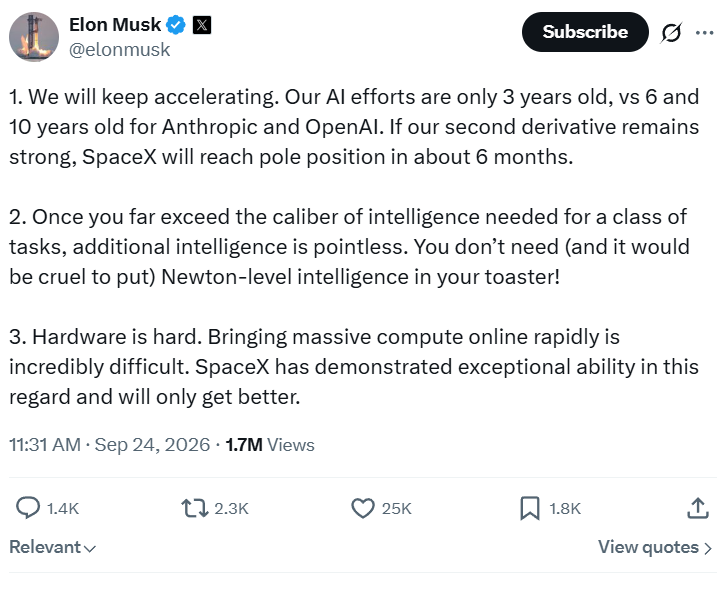
Elon Musk has spent months reminding critics that SpaceX’s artificial intelligence effort is young. On Thursday, he put numbers on it. He posted that the company’s AI work is three years old, compared with six years for Anthropic and 10 for OpenAI, and predicted SpaceX will take the lead in about six months if its rate of improvement holds.
He had two fresh exhibits. SpaceXAI released Grok 4.7 on Monday, Sept. 21, pitching it as the company’s strongest model yet for coding and knowledge work. On Tuesday, Tesla switched on Grok Bot inside its vehicles, turning the in-car assistant from something that answers questions into something that carries out tasks.
How much of this week is a product and how much is a press cycle depends on which piece you look at.
What Grok 4.7 is
SpaceXAI’s launch post says Grok 4.7 is built on a larger base model than Grok 4.6 and was trained with a longer reinforcement learning run weighted toward problems that take many hours to finish. The company says the model is better at verifying its own work and handling longer context.
The price did not move. Grok 4.7 costs the same as Grok 4.6: $2 per million input tokens and $6 per million output for prompts under 200,000 tokens, with cached input at 50 cents. At 200,000 tokens and above, the rates double to $4 and $12. The context window is 500,000 tokens.
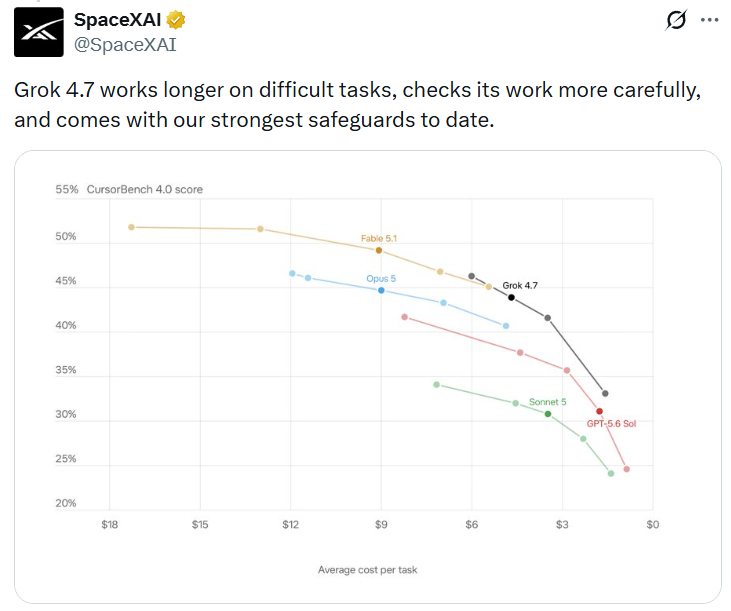
The headline benchmark numbers come from the company, and the comparisons aren’t apples to apples. SpaceXAI reports 46.3% on CursorBench 4.0 and 71% on DeepSWE, but most of its launch table set Grok 4.7 at its top “xhigh” reasoning setting against Grok 4.6 at the lower “high” setting. DeepSWE was the exception, run at high for both.
Outside scoring is less flattering. On CursorBench’s chart of accuracy against cost, Grok 4.7 lands in the middle, still behind Anthropic’s Fable 5.1 at every price point. Musk himself had lowered expectations days before launch, writing that the model should come in roughly even with Claude Opus 5.0 rather than Anthropic’s newer release.
That leaves value as the sales pitch. SpaceXAI markets the model as running twice as fast at half the price of comparable models. That’s the sticker price, and the bill per finished task can look different. At xhigh, Grok 4.7 used about 81,000 output tokens per task in independent testing, compared with 36,000 for Grok 4.6 at high, and the same testing found it cost more per task than a pricier-per-token OpenAI model.
Musk’s Thursday post leaned on three points. His AI lab is young and still accelerating. Once a model far exceeds what a job requires, extra intelligence is wasted: “You don’t need … Newton-level intelligence in your toaster,” he wrote. And standing up computing power fast is the hard part, which he argues SpaceX has already proven it can do.
There’s a twist on that last point. In May, SpaceX agreed to give Anthropic the full capacity of its Colossus 1 data center, more than 300 megawatts. Musk is renting the same scarce hardware to one of the labs he says he will pass.
In a separate post, Musk said he is cautiously optimistic SpaceX will have a Fable- or GPT-6-level model in two to three months. He has a record of dates that slipped, including years of fully driverless Tesla forecasts.
The Tesla engineer’s claim
The most concrete evidence came from inside Tesla. Yun-Ta Tsai, a senior staff engineer on Tesla’s AI team, said Grok Build teams spent the past few weeks tuning the harness for 4.7, and that many Full Self-Driving and Cybercab features he personally shipped were finished with help from his overnight agents. Musk highlighted the post Tuesday, saying Grok 4.7 is already doing real engineering work inside Tesla.
Neither man said which features were involved, and Musk gave no figures comparing the agents’ output with traditional engineering work. Nobody compared the results against Claude or OpenAI’s models either. It’s a real internal use case that remains unquantified. Tsai has said this before; in May he confirmed Grok Build had been used extensively in FSD and Cybercab development.
The car becomes the distribution channel
Tesla’s Tuesday post on X was blunt: “Grok in your Tesla can now do meaningful work for you.”