The Karbala on Ford Road: Dearborn and the Challenge of Assimilation
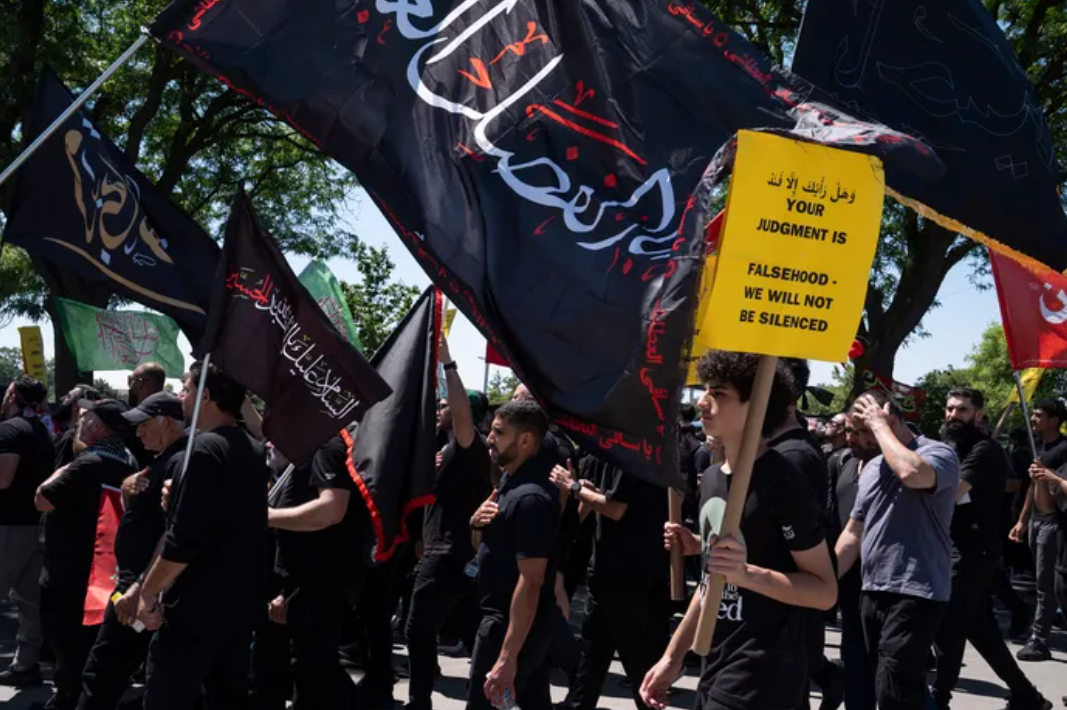
On Sunday, June 28, 2026, thousands filled the streets of Dearborn, Michigan, for the annual Ashura procession. Marching from Fordson High School to Ford Woods Park, participants dressed in mourning black carried flags honoring Imam Hussein, the grandson of Prophet Muhammad killed in 680 AD. Alongside these traditional religious symbols, however, hung banners evoking Hezbollah, Iran, and militant Palestinian causes, paired with signs declaring, “We do not bow to tyrants.”Dearborn is now the firs
On Sunday, June 28, 2026, thousands filled the streets of Dearborn, Michigan, for the annual Ashura procession. Marching from Fordson High School to Ford Woods Park, participants dressed in mourning black carried flags honoring Imam Hussein, the grandson of Prophet Muhammad killed in 680 AD. Alongside these traditional religious symbols, however, hung banners evoking Hezbollah, Iran, and militant Palestinian causes, paired with signs declaring, “We do not bow to tyrants.”
Dearborn is now the first Arab-majority city in the United States, with Middle Eastern and North African ancestry making up over 54% of the population. Mayor Abdullah Hammoud, the city’s first Arab-American Muslim mayor, addressed the crowd, explicitly linking the ancient seventh-century battle to modern geopolitical struggles. While the event was peaceful and legally protected under the First Amendment, the overt display of symbols mimicking U.S.-designated Foreign Terrorist Organizations on an American street raises a critical question: Where does religious freedom end, and solidarity with foreign political extremism begin?
The reality of modern Dearborn is the direct result of decades of chain migration—family-based immigration policies that allow arrivals to sponsor relatives, creating self-reinforcing networks from Lebanon, Yemen, Iraq, and Palestine. Combined with higher initial birth rates and intense geographic concentration, this rapid demographic shift has transformed neighborhoods into distinct, self-contained enclaves with their own mosques, businesses, and cultural institutions.
Historically, American ethnic enclaves—like those of Irish, Italian, or Polish immigrants—eventually assimilated because their cultural and religious frameworks fundamentally aligned with Western civic traditions. Dearborn presents a different trajectory. When an immigrant pocket reaches a critical mass, the incentive to assimilate into broader American norms plummets. Instead, the surrounding host culture is forced to adapt. Political power inevitably follows population, manifesting in local leadership, bloc voting on foreign conflicts, and public displays of transnational solidarity.
The participants marching through Michigan enjoy total freedom of speech, assembly, and religion—protections completely unavailable in the regimes whose causes they champion. They are not oppressed; they are empowered by the U.S. Constitution to challenge American values from within.
If current family-based immigration policies continue without enforcing strict expectations of assimilation, these parallel societies will expand. The consequences are predictable:
Cultural Friction: Growing demands for religious accommodations in secular public institutions.
Fractured Foreign Policy: Domestic voting blocs that prioritize overseas tribal and religious conflicts over American national interests.
Social Division: A fragmentation of the shared civic identity required to sustain a constitutional republic.
Welcome to Dearborn in 2026, where a seventh-century Middle Eastern conflict plays out openly on American asphalt. The urgent question facing the nation is whether America still possesses the cultural confidence to absorb and Americanize newcomers—or whether an unrestricted demographic shift will permanently rewrite the host culture instead.
Have a correction or tip? See our corrections policy or contact the newsroom.