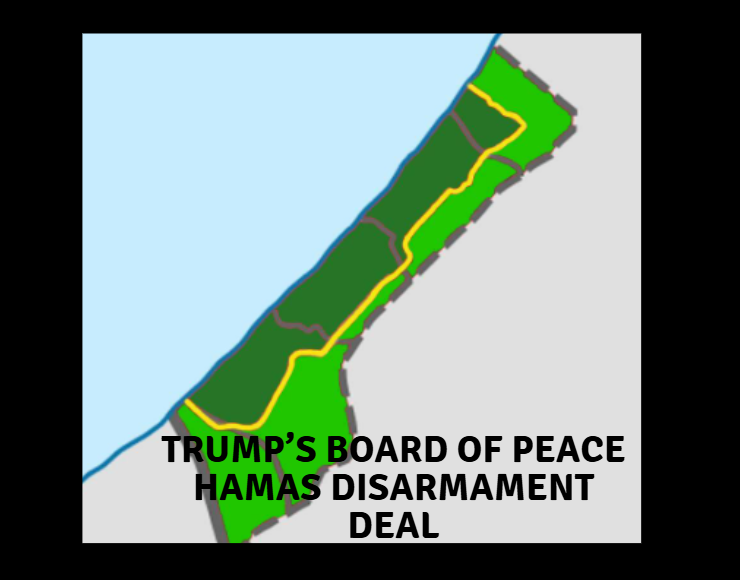
Trump calls it a monumental breakthrough. Israeli officials call it doubtful. Hamas says it won't move until Israel does. Here's what the agreement actually requires.
President Donald Trump announced Thursday that his administration's Board of Peace had reached what he called a “HISTORIC agreement for the COMPLETE DISARMAMENT of Hamas and all other armed groups in Gaza,” posting on Truth Social that it marked “a monumental step toward lasting PEACE and SECURITY.” The announcement followed months of mediation led by Egypt, Qatar and Turkey alongside the U.S.
What the Agreement Requires
According to a copy of the agreement obtained by Al Jazeera, Hamas and other Palestinian factions have agreed in principle to disarm, with a detailed roadmap for how that will happen due within 14 days, subject to extensions and approval from an international verification body. Weapons would be surrendered to a newly formed National Committee overseeing Gaza — not to Israel or any non-Palestinian body — with police weapons handed over first, followed by the decommissioning of heavier weapons.
As disarmament advances, Trump said Israeli forces would withdraw in “carefully structured phases,” beginning with a pullback to the so-called “Yellow Line” established after last October's ceasefire. According to Axios, the full process is expected to unfold over roughly seven to eight months of reciprocal, independently verified steps by both sides.
Reasons for Skepticism
Despite the celebratory framing, significant doubts remain on both sides. Axios reports Israeli officials remain deeply skeptical that Hamas will actually surrender its weapons, while comments from a senior Hamas official suggest the sequencing of disarmament and Israeli withdrawal could still be a point of dispute.
Hamas negotiator Ghazi Hamad told Al Jazeera the talks were “difficult and hard,” and said Hamas “will not take any steps regarding disarmament before Israeli withdrawal from the Gaza Strip” — a conditional stance that puts the two sides' sequencing expectations at odds before implementation has even begun.
Israel, for its part, has not publicly agreed to the latest proposal, according to Al Jazeera. And the backdrop complicates the picture further: since the U.S.-brokered ceasefire nominally took effect on Oct. 10, 2025, Israeli strikes have killed at least 1,100 Palestinians, according to Gaza health authorities. Israel has also expanded the military buffer zone known as the Yellow Line beyond its original positions and imposed tighter controls on the entry of goods and the operations of some international aid organizations, citing security concerns over diversion of supplies and staff affiliations. Some monitors and experts describe the Yellow Line expansion as inconsistent with the ceasefire maps.
What Happens Next
Egypt is expected to host follow-up talks with U.S., Qatari and Turkish representatives aimed at working out compliance mechanisms for this next phase. Questions that remain open include whether Palestinian armed factions beyond Hamas will actually adhere to the agreement, and whether Israeli forces will follow through on a full withdrawal as outlined.
For now, the agreement represents a diplomatic step forward on paper — a formal document both sides have engaged with, for the first time laying out a specific weapons-handover process. Whether it survives contact with implementation, over many months and multiple points where either side could stall, remains to be seen.
Sources:
Al Jazeera: "Gaza Board of Peace announces Hamas disarmament agreement: What we know"
Al Jazeera: "Hamas reaches Gaza disarmament agreement with Trump's Board of Peace"
The Jerusalem Post: "Donald Trump announces Board of Peace reached deal for Hamas disarmament in Gaza"
Axios: "Trump touts 'historic' agreement to disarm Hamas, rebuild Gaza"
Have a correction or tip? See our
corrections policy or contact the newsroom.