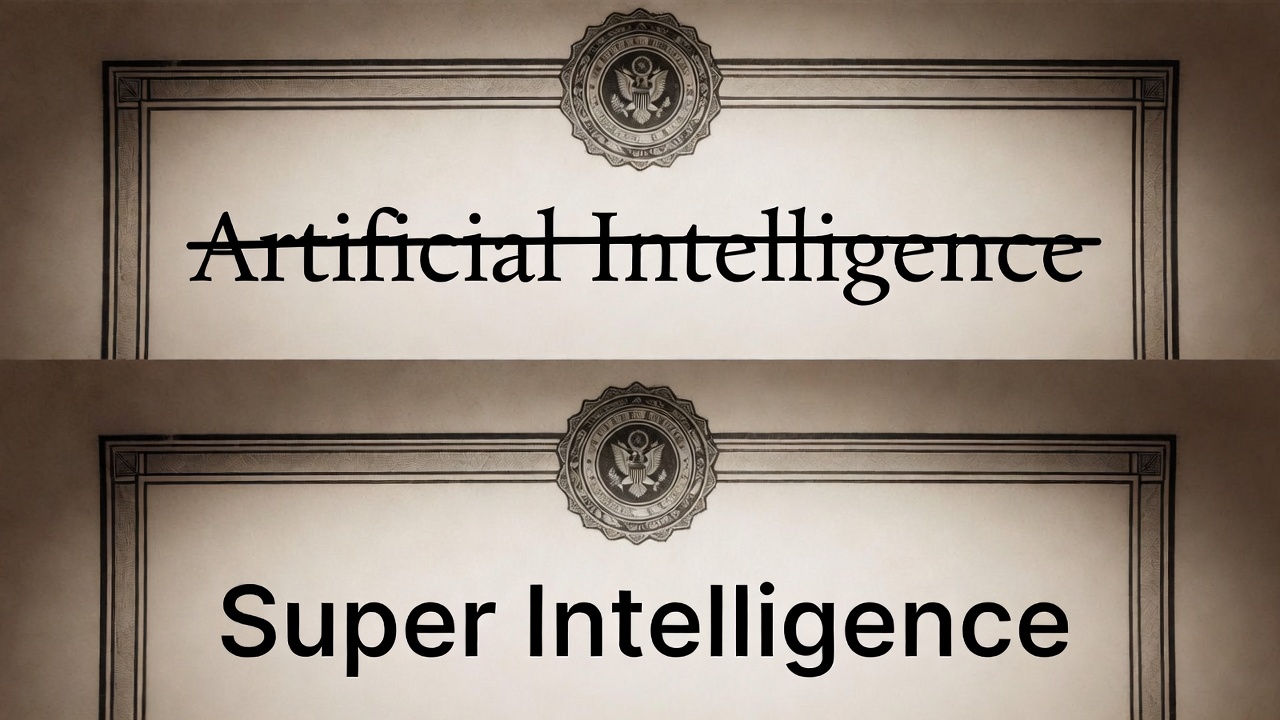
President Trump has ordered federal agencies to drop the terms "artificial intelligence" and "AI" from official communications and replace them with "Super Intelligence," or "SI." His stated reason is that the word "artificial" makes the technology sound fake. The issue is that "superintelligence" was never an unused marketing buzzword. It already had a rigorous meaning in computer science, describing capability far beyond any existing tool on earth.
What the order does
Trump signed the executive order following his address to the United Nations General Assembly, where he argued that the word artificial makes the technology sound fake when it is actually amazing. The directive orders executive departments to adopt "Super Intelligence" across agency websites, internal correspondence, and policy documents, while halting the use of "AI" in non-statutory materials.
The order also directs the Assistant to the President for Science and Technology to draft an official federal definition of the term and recommend implementation guidelines. In effect, the administration instructed federal staff to adopt the phrase before defining what it entails.
Compliance began immediately. On the day of Trump's UN speech, a State Department directive instructed personnel to replace all references to artificial intelligence with super intelligence across agency positions and records. American representatives have since used the term during a UN Security Council briefing on frontier technology risks, seated before executives from Anthropic, Hugging Face, and OpenAI.
A word that already had a job
Within computer science and technical safety research, "superintelligence" refers to a hypothetical system that outperforms human cognitive capability across every domain. It represents a theoretical milestone far beyond current generative tools and well past artificial general intelligence (AGI), which merely targets human-level reasoning. Neither system exists today. It has been reported that the White House did not consult technical researchers before issuing the directive, and that the mandate applies directly to everyday software already on the market, including commercial chatbots and workplace assistants, not to the more advanced concept the term was coined to describe.
The distinction matters because of the warning signals baked into the vocabulary. OpenAI itself has warned that genuine superintelligence could lead to the disempowerment of humanity or even human extinction, the exact risk level Trump's order now attaches to software that drafts routine correspondence. That is the gravity the term was designed to communicate.