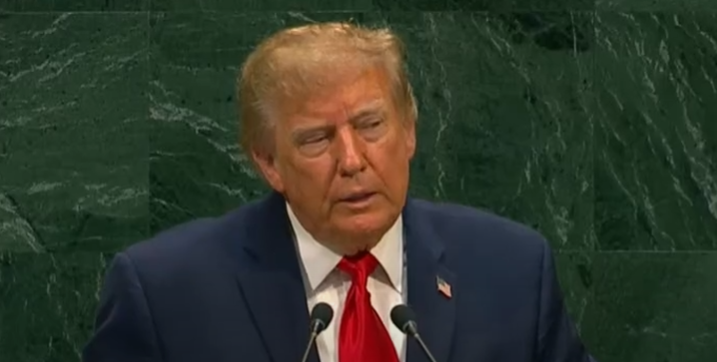
President Trump addressed the United Nations General Assembly in New York on Tuesday, Sept. 22, the second world leader to speak after Brazil's Luiz Inácio Lula da Silva, walking through a sweeping account of his second term, from the economy to Iran, Venezuela, Gaza, Greenland, NATO, and a push to rename artificial intelligence itself. His remarks on Iran came amid the administration's defense of the war the U.S. and Israel launched against Iran in February, at a moment when, The New York Times reported, some allies have begun openly questioning whether the U.S. remains a credible partner. What follows is a comprehensive record of what he said, organized by topic, with a note attached wherever a specific figure or event could be checked against outside reporting.
The Economy, By His Numbers
Trump opened with a broad domestic economic claim: that the country is “back and stronger than ever before,” citing new private-sector job growth since he took office, the lowest poverty rate in American history, and record-low poverty rates specifically for Black and Hispanic Americans. He credited his administration with removing regulatory obstacles on day one, cited the “largest tax cuts in American history,” and said the U.S. has secured roughly $21 trillion in investment commitments from around the world. He also claimed the most secure border in American history, with zero illegal crossings admitted, and credited federal crime crackdowns, naming Tennessee and Louisiana specifically, with the largest drop in violent crime.
These are the kind of claims that need independent verification before they're treated as settled fact. WECU's account of this section is drawn from real-time notes taken during the broadcast; these specific figures, the poverty numbers, the $21 trillion investment total, and the zero-crossings claim, did not appear in the published transcript excerpts WECU was able to cross-check, and none could be confirmed against Census, BLS, or CBP data before publication. Readers should treat these as reported, not yet independently confirmed, until that verification is complete.
Iran: “A Big Decision to Make”
The largest single section of the speech was Iran. Trump called it “the number one sponsor of terror,” saying “there is no better example of a danger that was allowed to gather strength at the world's peril than the number one sponsor of terror, the Islamic Republic.” He added: “They were the bully of the Middle East, but they are the bully no more.” He said he had urged Iran to make a deal and that Iran refused, and reiterated a version of his standing line that Iran will never have a nuclear weapon. He claimed Iran had built a missile capable of reaching Europe and said Iran was on what he called a “mad dash” to complete a nuclear bomb before military action stopped it.
He credited Operation Midnight Hammer, the June 2025 U.S. strikes on Iran's nuclear sites at Fordow, Natanz, and Isfahan, with having “obliterated their nuclear program,” a characterization the administration has repeated for months and that outside analysts still dispute the full extent of. Separately, he described Operation Epic Fury, the broader military campaign against Iran's conventional forces that followed, as having destroyed Iran's navy, air force, radar, and anti-aircraft defenses and devastated its economy, leaving inflation, which he put at 300%, as “the only thing not gone.”
He separately accused the Iranian regime of turning on its own people, saying it “slaughtered over 72,000 of its own citizens this year,” and adding, of a more recent crackdown, “Recently, 10,000 were killed for protesting.” That's an important distinction: this is not a war-casualty figure and isn't tied to Epic Fury, it's a claim about internal repression by Tehran, and it should be reported as such rather than folded into the war's death toll. The best independent estimates for total deaths across the entire 2026 Iran war, all countries, all sides, combined, compiled from OCHA, Iran's own health ministry, HRANA, and IDF figures, put that separate figure in the range of roughly 8,000 to 10,600, with Iran's own death toll estimated between 3,400 and 6,000.
Trump framed the road ahead as an explicit choice, in his words: “I have a big decision to make. Will a deal be made with Iran that lets them rebuild and create a far greater country than it ever was before, maybe one of the greatest in the Middle East or even the world. Or do I annihilate the Islamic Republic and do it quickly, never giving them a chance to kill and destroy people and countries again? Do I drive them into hell with no chance of survival and no hope of future greatness or generations?” He said Iran is “waiting to see the midterms,” but insisted that “doesn't even enter my mind. The only thing that does is that Iran will never have a nuclear weapon.” He also dismissed anyone claiming the U.S. is low on munitions as “cowards and traitors,” said the U.S. has more munitions than it could use and is building more, cited 18 new munitions plants under construction, a figure WECU has not independently verified, and said the U.S. can rapidly supply allies. He closed the section by calling on nations to join a “complete economic isolation of Iran.”
Gaza: Hostages, the 20-Point Plan, and the “Board of Peace”
Trump said the war in Gaza, raging a year ago, has ended under his administration, crediting the deal with saving thousands of lives and returning all remaining hostages, living and dead. He thanked the Security Council for endorsing what's formally his 20-point Gaza peace plan and the “Board of Peace,” the body he set up in January to oversee Gaza's governance and reconstruction, both of which are real, documented initiatives rather than claims unique to this speech. Rather than citing a round number of countries, he named specific contributors: Morocco, Bahrain, Qatar, Kuwait, Kazakhstan, Saudi Arabia, Turkey, and Uzbekistan on the reconstruction and relief side, and Indonesia, Morocco, Albania, Kosovo, Kazakhstan, Egypt, and Jordan, “and more,” as troop contributors to stabilization efforts, saying the funding goes directly to the source. He also claimed credit for settling multiple other conflicts beyond Gaza and Iran.
Venezuela: The Maduro Capture and an Oil Deal
Trump referenced the U.S. capture of Nicolás Maduro, calling him “the outlaw dictator,” and said Venezuelan political prisoners have been released. This is a real, well-documented event: U.S. forces captured Maduro in January 2026, and he has since faced arraignment in the U.S.; the Council on Foreign Relations and other outlets have covered the aftermath extensively.
He also announced what he called the largest oil deal in history between the U.S. and Venezuela, said major global oil companies are entering Venezuela, and, per WECU's real-time notes, claimed the combined U.S.-Venezuelan output would represent 60% of the world's oil supply, a figure that did not appear in the published excerpts WECU cross-checked and that is almost certainly a major overstatement; combined U.S. and Venezuelan crude production has historically been nowhere near that share of global output. WECU could not find independent confirmation of the deal's specific terms in time for this article. He used the phrase “to the victor belong the spoils” and said there would be “no threats to America,” backed by what he called unmatched military might.
Cartels and the Southern Border
Trump said he designated drug cartels as foreign terrorist organizations and directed the armed forces to treat cartel members as enemy combatants, citing a claimed 97% figure for drugs destroyed, a number WECU could not verify before publication. He referenced the killing of a top Tren de Aragua leader, which is accurate; U.S. forces killed the gang's alleged leader in a June 2026 strike, carried out with Venezuelan cooperation. He called Mexico the epicenter of cartel violence and said Mexico must reclaim its own territory from the cartels. He also referenced Cuba, calling it a failed state and saying Secretary of State Marco Rubio is negotiating with the Cuban government, declaring: “Communism will never be coming to America, but freedom will be coming to Cuba.” He cited an unnamed State Department report alleging cultivated ties between unspecified actors and Antifa, communist parties, and the Democratic Socialists of America.