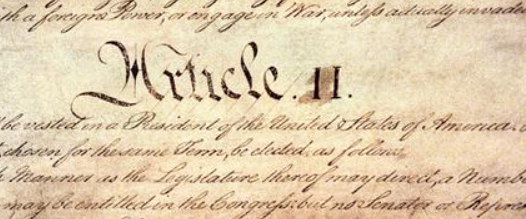
— Every time Congress fights over when to leave town, someone brings up Article II, Section 3 — the constitutional clause that supposedly lets the president force lawmakers back to work. It's come up during shutdown fights, during recess-appointment disputes, and most recently in the standoff over the SAVE America Act. This piece breaks down what the clause actually says, what real power it gives a president, and why it's one of the least-used provisions in the entire Constitution.
The Short Answer
Article II, Section 3 gives the president two distinct powers over Congress's schedule: the power to call Congress into a special session on "extraordinary Occasions," and — separately, and much more rarely — the power to set Congress's adjournment date himself, but only in the narrow case where the House and Senate disagree with each other about when to adjourn. The exact text reads: "he may, on extraordinary Occasions, convene both Houses, or either of them, and in Case of Disagreement between them, with Respect to the Time of Adjournment, he may adjourn them to such Time as he shall think proper."
Two Different Powers, Often Confused
The first power — convening Congress — is well established and has been used many times. Presidents have called special sessions of Congress 45 times in U.S. history, 27 of which involved recalling both chambers at once. George Washington used it to convene the Senate over nominations and to admit Vermont as a state. Abraham Lincoln called a special session of both chambers after the attack on Fort Sumter in 1861. This part of the clause is not controversial — a president asking Congress to come back into session is a normal, historically common act.
The second power is different, much narrower, and far more dramatic: the power to personally set Congress's adjournment date. But — and this is the detail that gets lost in most political arguments about it — this power only activates when the House and Senate are in an actual, formal disagreement with each other about when to adjourn. If the House and Senate agree on a schedule (even a schedule neither chamber is thrilled about), or if neither chamber has passed a resolution disagreeing with the other's timing, the clause's trigger condition simply isn't met.
Why No President Has Ever Actually Used It
Despite recurring political calls for a president to invoke this power, no president in American history has ever actually exercised it. There are two practical reasons why. First, the narrow trigger condition is difficult to meet — Congress rarely produces the kind of formal, on-the-record disagreement between chambers that the clause requires, since lawmakers generally find ways to agree on a recess schedule even amid unrelated political fights. Second, because the power has never been tested, using it for the first time would almost certainly trigger an immediate legal challenge that could end up before the Supreme Court, with genuinely uncertain results — there's simply no case law establishing exactly how far a president's authority under this clause extends in practice.