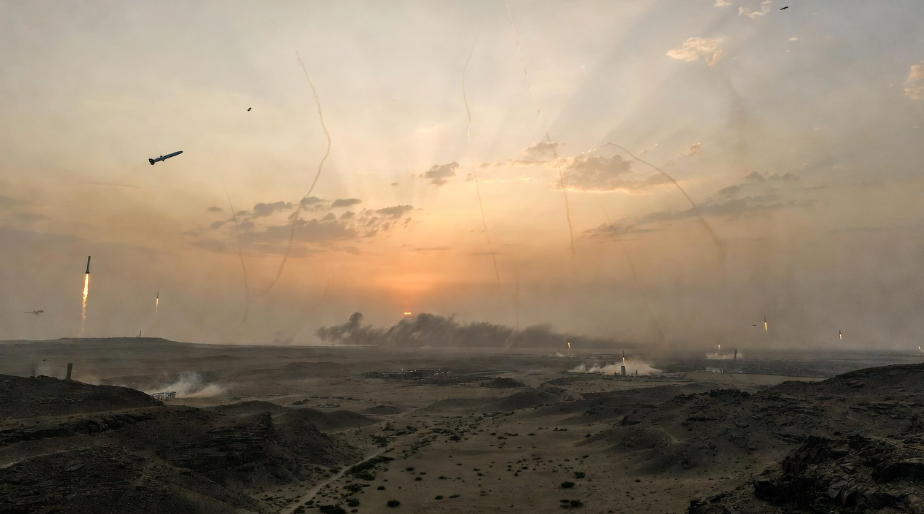
SANAA/RIYADH — Yemen's Iran-backed Houthi rebels killed at least 30 to 58 government troops in missile and drone strikes Thursday, in what regional reporting has called one of the deadliest days of Yemen's civil war in four years. The attacks struck government military camps in the Hadramout and Marib provinces, hitting forces that gathered for a morning training exercise — a detail that officials say drove the casualty count higher than it otherwise would have been.
The strikes didn't stop there. By Friday morning, Yemeni and Al Jazeera reporting said the Houthis had launched a fresh round of missile and drone strikes on the same two provinces — some accounts put the figure at roughly a dozen additional launches, though exact counts vary by source and appear to blend attempted strikes with government claims of intercepted drones. Separately, a senior Saudi military spokesman said a Houthi strike on Saudi Arabia's southern Najran province wounded 11 civilians — Saudi, Yemeni, Egyptian and Pakistani nationals among them, including a 4-year-old child who suffered second-degree burns.
This is no longer a contained skirmish. It's the sharpest escalation of Yemen's civil war since the Saudi-led coalition and the Houthis settled into a de facto truce in 2022 — and it's unfolding directly inside the wider US-Israel war against Iran that began at the end of February.
The chain of events is not hard to trace. On July 13, Yemen's internationally recognized government struck Sanaa's airport to block an Iranian aircraft it accused of using civilian cover to ferry equipment to the Houthis. The Houthis retaliated with missiles at Saudi Arabia, then imposed a maritime blockade on July 20 disrupting oil shipments and striking Saudi state oil giant Aramco's facilities in Jizan and Yanbu. Saudi Arabia responded by forming an international naval coalition to guard the Red Sea, with roughly a dozen countries signing on so far.
What makes this moment more dangerous than the prior four years of intermittent strikes is what intelligence agencies are now saying about who's actually directing it. A senior Saudi official told Reuters that intelligence from the United States, Saudi Arabia and other Middle Eastern governments warns the Houthis and Iraqi armed groups — under the direct supervision of Iran's Islamic Revolutionary Guard Corps — may be preparing coordinated strikes on Saudi energy infrastructure, ports and airports. Analysts tracking the region say Iran's role has shifted from quiet backing to explicit endorsement: Tehran is now publicly defending Houthi demands rather than working through intermediaries, extending its leverage from the Strait of Hormuz to a second maritime chokepoint, the Bab al-Mandeb strait.