The announcement of a $100 billion SpaceX spaceport in Vermilion Parish has put a once-fringe idea into the middle of the national conversation: data centers that don’t sit on the ground at all, but orbit the Earth. Here’s what that actually means.
Data Centers in Orbit: What They Are, How They Work, and Why Everyone From Google to SpaceX Wants One
How do you put a data center in space, and why is everyone from Google to SpaceX racing to do it? A full breakdown — plus a hypothesis on Elon Musk's next move that no one else is reporting yet.
By Lynn Matthews - August 26, 2026
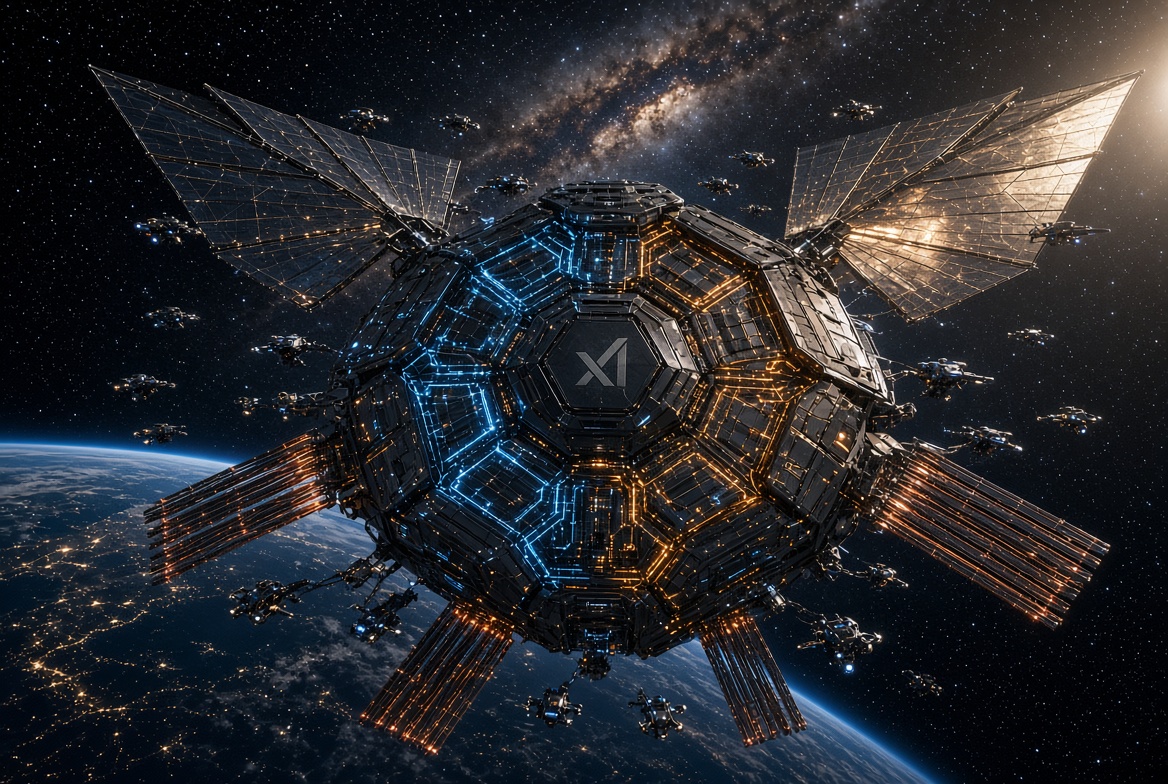
An orbital data center is exactly what it sounds like — computer servers and processors, the same kind that power AI models and cloud storage on Earth, mounted on satellites instead of housed in warehouses. Instead of pulling electricity from a power grid and cooling systems from water or air conditioning, an orbital data center draws power directly from the sun and dumps heat into the vacuum of space.
Why Space, Specifically
Two resources are becoming the biggest bottlenecks for AI on Earth: electricity and land. A single large AI data center can use as much power annually as 100,000 households, and terrestrial data centers are on pace to consume more than 1,000 terawatt-hours of electricity this year alone — roughly a third of all the power produced by nuclear plants worldwide.
Space offers a way around both constraints. In the right orbit, a solar panel can generate up to eight times more power than an identical panel on Earth, because there’s no atmosphere, no clouds and no nighttime to interrupt it. Land isn’t a factor at all once a satellite reaches orbit.
Who's Actually Building This
This isn’t theoretical anymore. A Washington state startup called Starcloud put the first data-center-grade chip, an NVIDIA H100 GPU, into orbit in November 2025, and used it to train a small language model in space the following month. Google’s Project Suncatcher aims to link solar-powered satellites carrying the company’s own custom TPU processors into an orbital computing cluster, with prototype satellites targeted for 2027. Axiom Space and Kepler Communications launched the first orbital data-center nodes in January 2026. And SpaceX filed with the Federal Communications Commission in January to deploy up to 1 million solar-powered satellites functioning as data centers in low Earth orbit — the project widely referred to as Starmind, and the one this outlet connected to the Vermilion Parish spaceport weeks before Tuesday’s announcement.
The Real Bottleneck: Getting There
The biggest obstacle isn’t the technology — it’s the cost of launch. Getting a satellite into orbit today runs roughly $2,700 per kilogram on a Falcon 9 rocket. Industry analysts generally agree that space-based computing becomes cost-competitive with terrestrial data centers once launch costs fall to around $500 per kilogram — a threshold SpaceX’s Starship rocket is explicitly designed to hit. That single number is why Starship’s launch cadence, not just its payload capacity, is the real story behind Starbase, Louisiana.
Other challenges remain real: radiation exposure degrades computer chips over time, satellites have limited ability to be physically repaired, and moving enormous amounts of data between orbit and Earth requires laser-based optical links still being proven at scale.
Analysis: Why This Could Be More Than a Compute Cluster
Several data points, taken together, point toward a possibility no outlet has reported yet: that Starbase, Louisiana’s role may extend beyond conventional AI compute into quantum computing.
The evidence trail starts with Musk himself. On the All-In Podcast this year, he laid out a detailed technical case for quantum computing in space, specifically citing permanently shadowed craters — whether lunar or, by extension, any sufficiently isolated environment — as ideal for qubit stability: temperatures below -200°C for natural cooling, near-vacuum conditions minimizing interference, and distance from the solar radiation that Google’s own research has shown increases quantum error rates. He described this as “Gigahard” infrastructure thinking that goes beyond Earth-bound limitations.
Layer that onto what’s now confirmed about Starbase, Louisiana: a facility built for a launch cadence of more than 30 Starship flights per day, tied to an FCC filing for up to 1 million satellites, on a coastal site chosen specifically for a launch corridor over open water rather than population centers. That is significantly more launch infrastructure than conventional solar-powered AI compute satellites — the kind Starcloud and Google are already flying — appear to require.
Musk has not said Starbase, Louisiana is intended for quantum computing, and no public filing confirms it. This is a hypothesis, built from Musk’s own public statements and the scale of what’s being built — not a report of fact. But given his demonstrated interest in exactly this pairing of space and quantum infrastructure, and this outlet’s track record of connecting the dots on this project before official confirmation, it is a possibility worth laying out now.
Sources:
Fierce Network, “Space data centers: Starcloud, SpaceX and Project Suncatcher explained,” 2026: https://www.fierce-network.com/cloud/space-data-centers-starcloud-spacex-and-project-suncatcher-explained
Introl, “First Orbital Data Center Nodes Reach Space,” Jan. 20, 2026: https://introl.com/blog/orbital-data-center-nodes-launch-space-computing-infrastructure-january-2026
Sterne Kessler, “When the Cloud Leaves Earth: Protecting Data Center Innovation in Orbit,” July 31, 2026: https://www.sternekessler.com/news-insights/insights/when-the-cloud-leaves-earth-protecting-data-center-innovation-in-orbit/
JLL, “Data centers in space,” June 9, 2026: https://www.jll.com/en-us/insights/data-centers-in-space
Quantum Zeitgeist, “What Elon Musk Really Thinks About Quantum Computing,” April 8, 2026: https://quantumzeitgeist.com/elon-musk-on-quantum-computing/
WECU News, “SpaceX’s Louisiana Spaceport Is About More Than Rockets — It’s About Putting AI Data Centers in Orbit,” Aug. 9, 2026: https://wecunews.com/spacexs-louisiana-spaceport-about-more-than-rockets-about
Topics:orbital data centers explainedspace based data centersSpaceX Starmind satellitesGoogle Project SuncatcherStarcloud NVIDIA orbitAI data centers in spaceStarbase Louisiana data centerElon Musk quantum computingspace solar powered satellitesAI how do space data centers work
Have a correction or tip? See our corrections policy or contact the newsroom.
Comments
to join the discussion.
Loading comments...