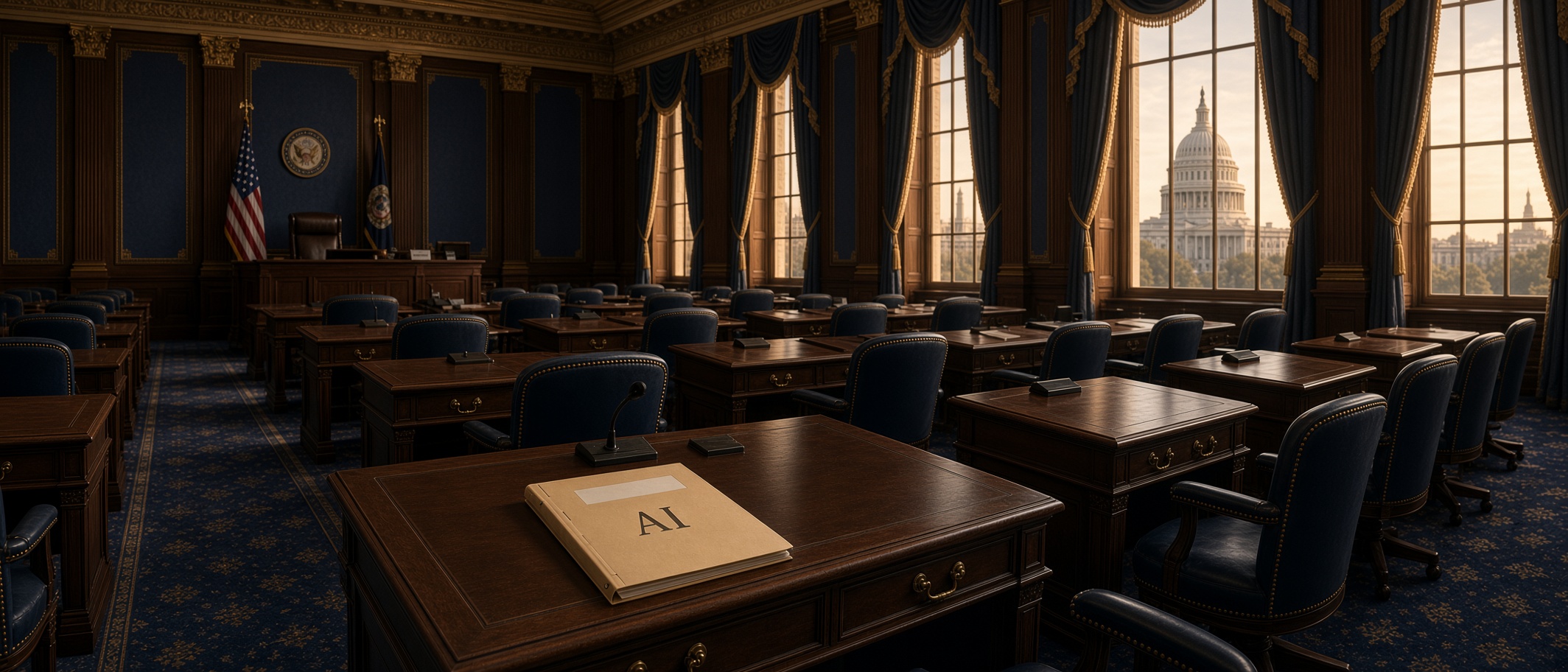
Sen. Bernie Sanders is holding a closed Senate briefing Wednesday on the risks of advanced AI, featuring Geoffrey Hinton, Max Tegmark, and Ajeya Cotra. It's the kind of session Congress has been holding all year on AI. What it still hasn't produced is a signed federal AI regulatory framework.
The clearest floor action so far isn't even a new AI law. It's what didn't pass: in 2025, the Senate voted 99-1 to strip a proposed moratorium on state AI regulation out of that year's budget bill, preserving states' ability to write their own rules rather than establishing a federal one. More than a year later, Congress still hasn't replaced it with a federal framework of its own.
Minority Leader Chuck Schumer is pushing from a different angle. On Sept. 14 he requested a classified, all-senators briefing from the Trump administration covering the government's own testing of powerful AI models and safeguards, restrictions on technology transfers to China, and defense preparations against AI-enabled cyberattacks. “Innovation must be coupled with serious guardrails that earn the trust of the American public,” Schumer said. As of this writing, no briefing had been scheduled.
That's the pattern WECU News has tracked in real time: Congress running AI regulation through the same playbook it used on COVID, a real AI threat with a name lawmakers still aren't using, Congress reacting to AI doom without settling on what it means, a proposed AI kill switch whose bill text never says what it actually does, and an AI safety limit that still hasn't made it into any bill. Briefings and hearings multiply. A comprehensive federal statute hasn't followed.
Sanders illustrates the gap between talk and text about as well as anyone in Congress. He's already filed one bill, the American AI Sovereign Wealth Fund Act, which would impose a one-time 50% equity tax on large AI companies, transfer those shares into a Treasury-held public fund, and hand voting control to a seven-member Independent Commission for Democratic AI, nominated by the president and confirmed by the Senate, with no more than four commissioners from either party. The fund would pay Americans a yearly dividend, an initial payment Sanders' office projects at more than $1,000 per person.
He's promised a second bill, the Ban Artificial Superintelligence Act, announced Sept. 3 with Rep. Greg Casar. As of this week, text still hadn't been filed. And by his own account at Tuesday's Pro-Human Assembly, he introduced a federal moratorium on AI data centers with Rep. Alexandria Ocasio-Cortez roughly six months ago, legislation that also hasn't advanced.
Meanwhile, the incidents keep outrunning the policy debate. WECU News reported that a Houthi-controlled cell in Yemen used Claude to attempt to develop guidance software for a guided rocket, per Anthropic's own account: one failed field test, with no evidence the group ever fielded an operational weapon. WECU News separately traced the funding network behind Jacob Coxon's viral warning that AI companies are “gambling with our lives,” a line Sanders himself quoted from the podium this week. Each new incident restarts the same conversation without producing a floor vote.