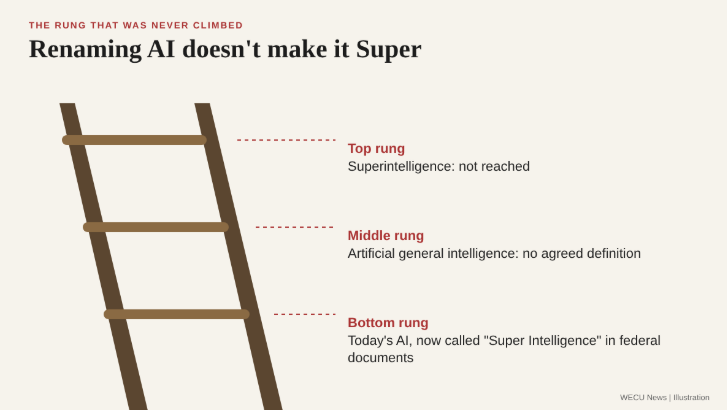
A new executive order swaps “AI” for “Super Intelligence” in federal documents. The law underneath did not change, and the gap deserves a hard look.
On Sept. 29, the president signed an executive order directing federal agencies to say “Super Intelligence” and “SI” wherever they once said “artificial intelligence” and “AI” in official communications. Trump said the new term “more appropriately captures the promise, potential, and rapidly advancing capabilities” of the technology. The order makes no distinction between AI and artificial general intelligence. I reported the order itself on Sept. 30. This is the argument that follows.
The part that deserves more attention is what the order leaves alone. It borrows the existing statutory definition of AI and does not rewrite existing regulations or contracts. Agencies will speak in one vocabulary while statutes, state laws and contracts keep using another.
I like AI. I hope it helps people live longer and untangles problems that human engineers have left stuck for years, such as the timing of traffic lights in my own city. That is why labels matter to me. A technology that earns a bigger name through results has earned it. A technology handed the name first is judged against promises it has not yet kept.
Researchers have never agreed on where artificial general intelligence begins, and that disagreement was already a problem. If official documents describe today’s systems with the word “super,” the milestone people were waiting to recognize becomes harder to mark, because the language has already moved past it. I cannot prove what readers will conclude. I can say that headlines, memos and press releases shape what people assume, and most of us skim.
Consider the lawmaking side. Sen. Bernie Sanders has announced legislation to ban artificial superintelligence. What does such a ban cover when the executive branch uses the same word for everything it used to call AI? Lawmakers and courts will have to answer that, and the order gives them no help.
Congress is not idle on every front. Sens. Josh Hawley, a Missouri Republican, and Chris Murphy, a Connecticut Democrat, are putting forward a bipartisan bill that would make AI companies liable when their agents cause harm, such as a hack. A liability law has to say exactly what it covers, and it will be read against an executive branch that now uses one word for every system. Whether “super” is a marketing term or a legal one is a question the drafters will have to answer.
None of this settles the safety debate. Researchers inside the labs say the risk is serious, and Anthropic’s own IPO prospectus warns of “existential risk to humanity.” I take that seriously. My argument concerns vocabulary. Warnings of doom and a relabel that promises greatness are both loud, and both ask the public to react before the facts arrive.
The accord that tech executives signed alongside the order is described as morally binding rather than legally enforceable, which is another way of saying voluntary. Congress, meanwhile, leaves town until after the November election. A new name and voluntary promises make a thin foundation for a technology this powerful.
Precise words let us hold people to what they say. If a system ever reaches the point where “super” fits, we should be able to say so, and we should still be able to recognize it when it happens. Today the technology in question is still AI.
Sources:
Fox Business: Trump signs order rebranding AI as Super Intelligence
IAPP: White House directs agencies to adopt “super intelligence”
Axios: AI executives, Trump agree to voluntary safety standards
NPR: Congress is under pressure to act on AI
WECU News: The Money Behind the Viral Anthropic AI Doom Post
Have a correction or tip? See our
corrections policy or contact the newsroom.